
Vein cut or cross cut travertine — which should you specify?
The short version
Vein cut saws across the layers of travertine and shows long, straight lines. Cross cut, also called fleuri, saws along them and shows a soft, cloudy pattern. Choose vein cut for directional, architectural surfaces and cross cut for calm, large floors, and approve the cut on a physical sample.
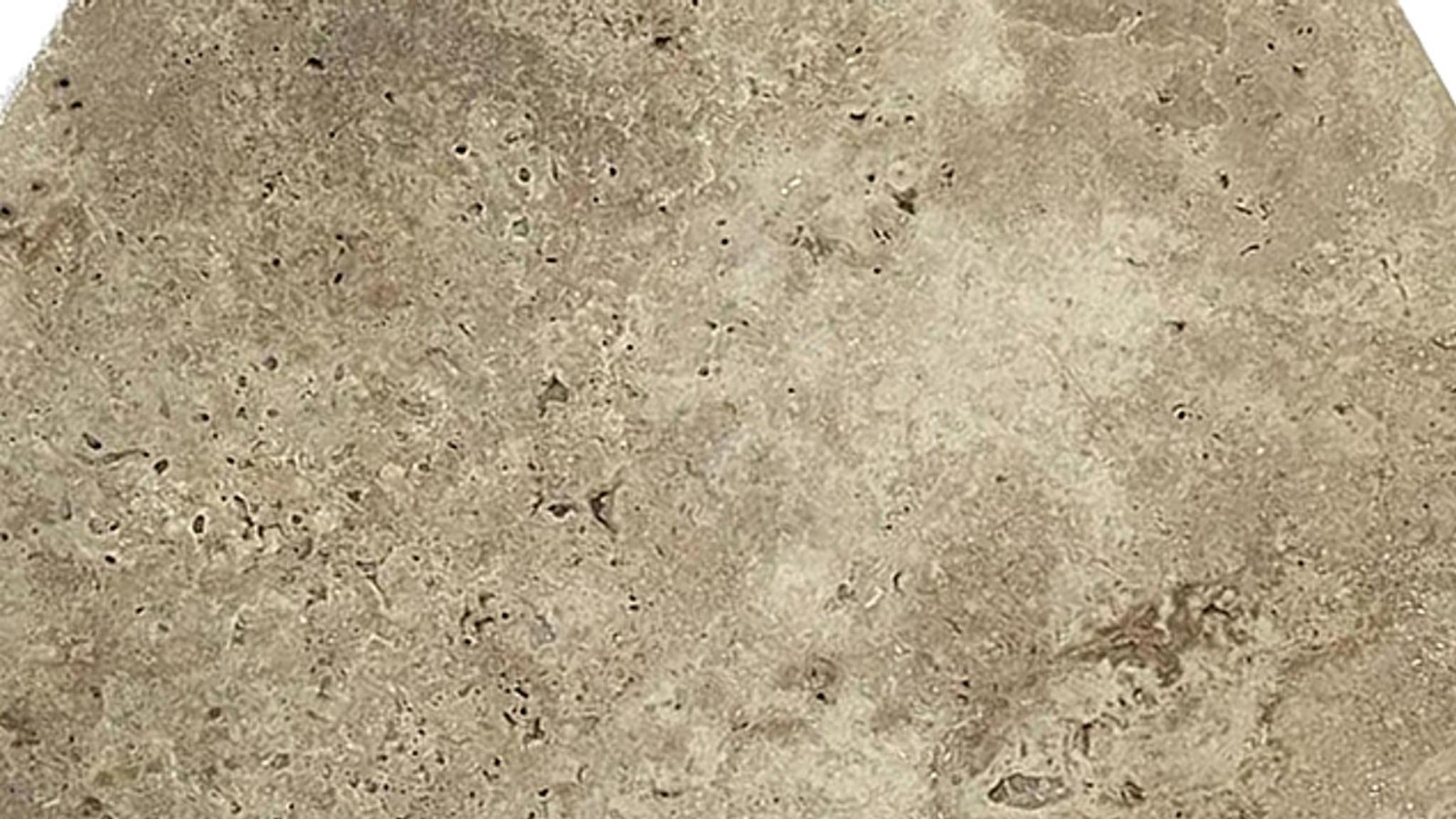
What is the difference between vein cut and cross cut travertine?
Travertine forms in layers. The difference between the two cuts is the direction of the saw through those layers. The stone itself is the same, and both cuts can come from the same block.
Vein cut goes across the layers, so the face shows their edges as long, straight lines. Cross cut goes along the layers, so the face shows a soft, cloudy pattern with no clear direction. Cross cut is also called fleuri cut.
ASTM C1527, the US specification for travertine dimension stone, uses the same split: fleuri-cut or cross-cut is parallel to the natural veining, and vein-cut is perpendicular to it.
Why do suppliers describe the cuts differently?
Supplier websites do not agree on the geometry. Some say vein cut runs parallel to the bedding, others say it runs across it. The words are used loosely, so do not rely on them alone.
The appearance is the reliable test. Linear stripes mean vein cut, and a cloudy, random pattern means cross cut. If a quotation only says "vein cut", check it against a physical sample before you approve the order.
How do vein cut and cross cut compare?
| Feature | Vein cut | Cross cut (fleuri) |
|---|---|---|
| Saw direction | Across the natural layers | Along the natural layers |
| Pattern | Long, straight lines | Soft, cloudy, random |
| Direction on the surface | Clear, so it must be planned | None, so it is easier to lay |
| Joins between pieces | Lines may not meet, so joins show more | Pattern blends across joins |
| Voids on the face | Follow the lines | Scattered, and can be wider |
| Typical effect | Modern, architectural | Calm, traditional |
Does the cut change how the stone performs?
It can. Travertine has different properties in different directions, so the cut is a technical choice as well as a visual one.
ASTM C1527 warns that fleuri-cut travertine can cause problems that vein-cut stone does not, because parts of the exposed face may be only a thin layer of stone over a void. On a floor, those areas deserve attention. Filling the voids, and checking the filled face on a sample, helps to manage this.
A study of travertine from six quarries, published in the Turkish Journal of Earth Sciences, measured abrasion on samples cut perpendicular and parallel to the bedding. All the perpendicular samples lost less surface in the Böhme abrasion test. The author linked this to smaller, less connected pores on that face.
Direction matters for strength too. A study of Denizli travertines in Engineering Geology reported strength 1.44 times higher under loading parallel to the lamination than perpendicular to it. Compressive strength across the stones studied ranged from 9.58 to 132.32 MPa, so the source of the stone matters as much as the cut.
These are individual studies, and they do not make one cut the better choice for every floor. Choose the cut for the design and the use, and approve it on a sample of the stone you are buying.
Which cut suits which project?
- Large floors in hotels and commercial buildings: cross cut hides joins and gives a calm, even surface across big areas. Check the voids and the filling on a sample first.
- Feature walls, reception desks and lift lobbies: vein cut gives strong lines that the design can use.
- Long corridors and narrow rooms: vein cut can make a space feel longer or wider, depending on the direction you choose.
- Exterior paving and pool areas: the cut is mainly a visual choice here. The finish, the filling and the local climate matter more, so decide those first.
- Mosaics and small formats: the pattern has less room to show, so the difference between the cuts is smaller. Colour and finish usually matter more.
Finish changes the look of both cuts. Our guide to stone finishes compares honed, polished, tumbled and brushed surfaces.
How should you write the cut into a specification?
A specification that says only "travertine" leaves the cut to the supplier. Name these points, and repeat them on the purchase order.
- Cut: vein cut or cross cut (fleuri), with the sample reference
- Line direction for vein cut: along the length of the tile or across it, and which way it runs on the drawings
- Filling: filled or unfilled, and the filler colour
- Finish, size, thickness and edge detail
- The acceptable range of colour and line variation, shown with several approved pieces rather than one
For vein cut, plan the layout before ordering, because the lines will show any change of direction. Keep to one cut across a space unless the design calls for both.
Ordering vein cut or cross cut travertine
We produce both vein cut and cross cut travertine at our factory in Denizli, Türkiye, for wholesale and project orders. Tell us the cut, line direction, filling, finish, size and total quantity, and approve the cut on a sample before production starts. For the wider picture on supply, see travertine from Turkey.
Frequently asked questions
- Is cross cut the same as fleuri cut?
- Yes. Both names describe travertine cut along its natural layers, which gives a soft, cloudy pattern. ASTM C1527 treats fleuri-cut and cross-cut as the same thing.
- Is vein cut travertine stronger than cross cut?
- Not as a general rule. Travertine behaves differently in different directions, and the stone itself matters as much as the cut. Choose the cut for the design and the use, and approve it on a sample.
- Can vein cut and cross cut come from the same block?
- Yes. They are the same stone cut in two directions, so the difference comes from how the block is sawn rather than from the material.
- Can you mix vein cut and cross cut in one project?
- Yes, as a design decision. One common approach is cross cut on large floors and vein cut on feature walls. Approve samples of both together, because the two cuts can read as different colours.
Sources
- ASTM C1527/C1527M, Standard Specification for Travertine Dimension Stone
- Gökçe, M. V. (2015). The effects of bedding directions on abrasion resistance in travertine rocks. Turkish Journal of Earth Sciences, 24(2), 196-207
- Çobanoğlu, İ., Çelik, S. B. (2012). Determination of strength parameters and quality assessment of Denizli travertines (SW Turkey). Engineering Geology, 129-130, 38-47