
Marble pencil liner, listello and border trim: what they are and how to use them
The short version
Stone trim finishes, frames or divides a tiled surface. A pencil liner is a thin strip that frames a mosaic or the edge of a backsplash; a listello is a border tile that breaks a surface or marks a change of design; a border is a wider band, usually on floors. A bullnose is the tile with its own edge finished, and a metal profile protects an edge with a thin metal line. Order trim by length, with the tile, so the stone and finish match.
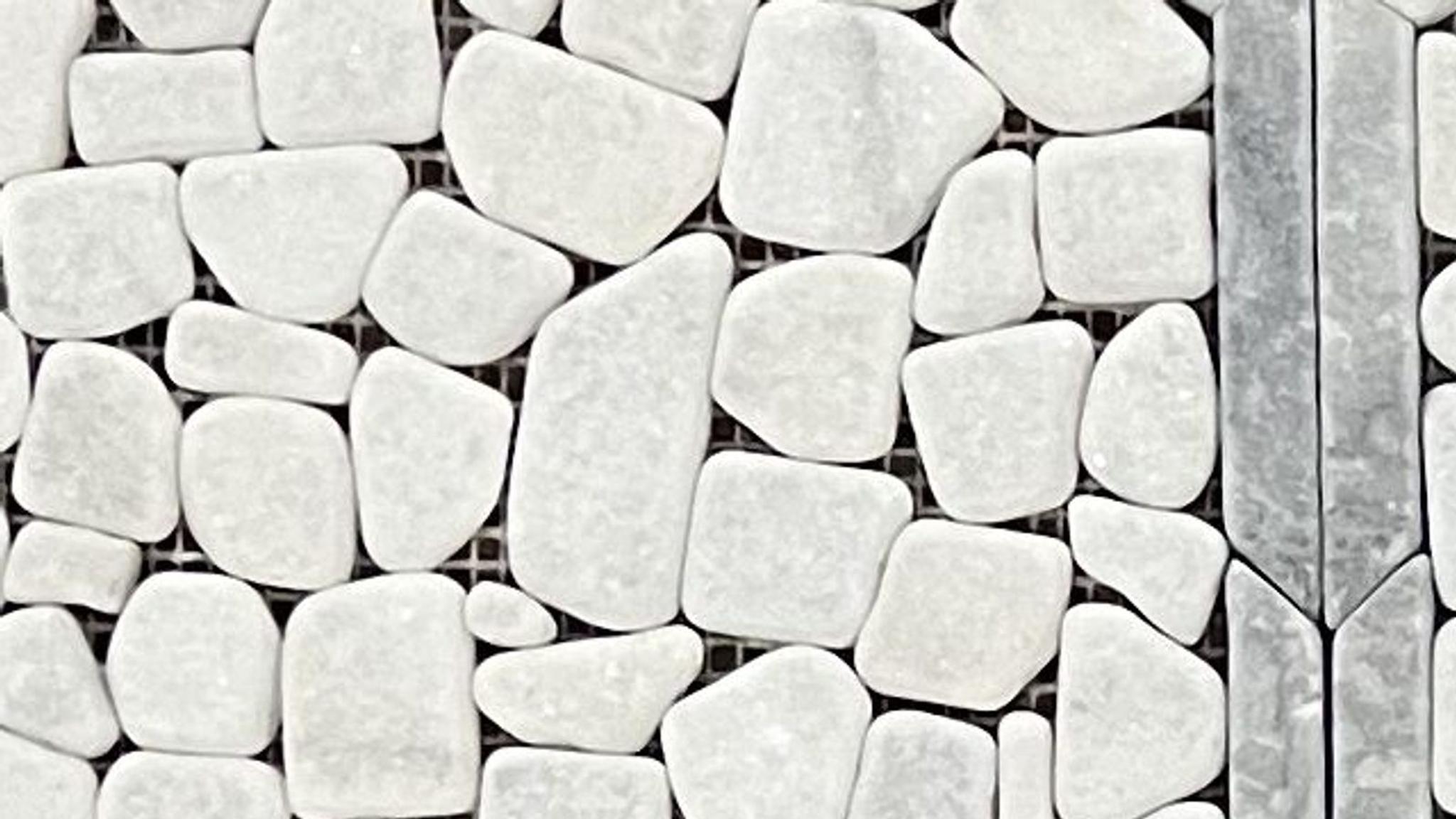
What is stone trim?
Trim is the narrow stone that finishes, frames or divides a tiled surface: the pencil along the top of a backsplash, the band that runs across a shower wall, the border around a mosaic floor. It does two jobs. It hides edges that would otherwise look unfinished, and it adds a line of colour or texture that the tile alone does not have.
Stone tile and mosaic need it more than most surfaces. A mosaic sheet rarely ends in a straight line: hexagon, herringbone, fan and waterjet patterns leave stepped or cut edges. And a sawn edge does not match a polished or honed face, so wherever the side of a tile is on show, it has to be finished, covered or framed.
What are the types of trim?
| Piece | What it is | Where it is used |
|---|---|---|
| Pencil liner | A thin, narrow strip of stone, usually with a rounded face, about the width of a pencil | Framing a mosaic, finishing the top or side of a backsplash, outlining a niche |
| Listello | A border tile that creates a break in a tiled surface or a transition from one design to another | A band across a shower or bathroom wall, between a mosaic and plain tile |
| Liner | The general name for a thin or narrow decorative tile; pencils and listellos are both liners | Lines that break up a wall pattern |
| Stone border | A wider strip or band of plain stone or mosaic, in a matching or contrasting colour | Framing a floor, making a stone "rug", edging a feature wall |
| Chair rail (dado rail) | A horizontal trim piece along a wall | The top of a half-height wall of tile (wainscot) |
| Bullnose | A tile with a rounded, finished edge | Edges of tiled walls and showers, wall tops, steps |
| Base (skirting) | Trim that covers the joint between the wall and the floor | The foot of a wall above a tiled floor |
| Metal profile | A metal edge strip set into the adhesive under the last row of tile | Exposed edges, outside corners, transitions to another floor |
Names vary between countries and suppliers. A chair rail is usually called a dado rail in the UK, a base a skirting, and "listello" and "liner" are sometimes used for the same piece. Describe the piece by its shape, size and position when you order it, not only by its name.
Pencil liner, bullnose or metal profile?
These are the three usual ways to finish the edge of a stone surface, and they give different results:
- Pencil liner: a separate strip of stone set along the edge. It frames the surface and adds a line, in the same stone for a quiet finish or a contrasting one for a sharp outline. It is the most decorative of the three.
- Bullnose: the field tile itself, with its edge rounded and finished. The surface simply stops, with no extra line. With stone, the rounded edge has to be finished to match the face, honed edge for a honed tile, polished for a polished one.
- Metal profile: a strip of metal set under the last row of tile, so only a thin line of metal shows. It protects the edge and suits outside corners and modern designs. Choose a profile matched to the thickness of the tile.
A pencil is usually a different thickness from the tile beside it. On a wall that is often the point, because it stands slightly proud and casts a line of shadow. On a floor, or anywhere it can be caught, keep the trim flush with the tile.
Listello, liner or border?
A listello breaks a tiled surface or marks the change from one design to another: a band of mosaic across a shower wall of plain tile, or a strip between a patterned floor and its plain surround. A liner is the general name for any narrow decorative piece, so a listello is one kind of liner and so is a pencil.
In stone, a listello is often made as a strip of mosaic, such as a narrow band of herringbone, basket weave or brick, or as a solid strip with a contrasting colour or finish. A border is the same idea on a larger scale, usually on floors: a band of stone around a room, a hall or an inlaid panel.
Where does trim go?
- Backsplashes: along the top edge and the open sides, where a mosaic sheet stops short of a cabinet or a wall.
- Shower walls: a listello or pencil as a horizontal band, and pencils around a niche, so the cut edges of the niche are covered.
- Half-height walls: a chair rail or pencil to cap a wall of tile that stops partway up.
- Feature walls: a frame of pencils or a border round a mosaic panel set into plain tile.
- Floors: a border round a room or a stone rug, and a base along the walls.
- Transitions: a metal strip where a stone floor meets wood, carpet or another floor.
For the edges of a kitchen backsplash, see our guide to mosaic backsplashes. For niches and shower walls, see travertine, marble and limestone in showers.
How do you match trim to the tile?
- Same stone for a seamless finish: trim cut from the same stone as the mosaic or tile frames it without drawing attention.
- Contrast for a frame: black with white marble, a darker travertine against a light one, or a polished pencil beside a honed field.
- Same production for colour: natural stone varies from block to block, so order the trim with the tile or mosaic it goes with, not later.
- Finish for the place: polished trim is fine on walls; on floors, and where it gets wet underfoot, choose honed or tumbled.
For the difference between polished, honed, brushed and tumbled, see our guide to stone finishes.
How much trim do you need?
Trim is measured by length, not by area. To work out an order:
- Measure every run that needs trim, in metres or feet: the top and sides of a backsplash, each band across a wall, each side of a niche or a border.
- Count the corners. Outside and inside corners are usually mitred, cut at an angle so two pieces meet, and each mitre uses some length.
- Add an allowance for cuts and breakage, agreed with your installer, because short runs and many corners waste more than one long run.
- Check the joints: plan where trim pieces meet so the joints line up with the grout joints of the tile where they can.
How do you install stone trim?
Stone trim is set with the same materials as the stone around it:
- A white, polymer-modified thin-set made for natural stone, so grey does not show through light marble.
- Full coverage: narrow pieces have little contact area, so butter the back of each one as well as the wall, and check none is loose or hollow.
- Dry-lay first: set out the trim with the tile, so the joints and corners fall where you want them before anything is fixed.
- Unsanded grout on polished trim and in narrow joints, because sanded grout can scratch polished stone.
- Seal honed and tumbled pieces before grouting, especially with a contrasting grout.
- A flexible joint, not grout, where the tile meets another plane: the foot of a base against the floor, and where a backsplash meets the worktop. Base is set after the floor and before grouting.
Our guide to installing marble mosaic covers the steps for the mosaic itself, and our guide to sealing covers sealers.
Stone trim from our factory
We make pencil liners, listellos, stone borders, chair rails, bullnose edges and skirting in marble, limestone and travertine at our factory in Denizli, Türkiye, together with the mosaics and tiles they finish, for wholesale and project orders. Making the trim with the mosaic means the stone and the finish match. Tell us the stone, the finish, the shape and size of the piece and the total length, and we will quote for your specification; any size can be cut to order. See our marble mosaics, herringbone mosaics and hexagon mosaics, or our Turkish Carrara marble.
Frequently asked questions
- What is a pencil liner?
- A thin, narrow strip of stone or tile, usually with a rounded face, used to frame a mosaic, finish the edge of a backsplash or outline a niche. In marble it is often cut from the same stone as the mosaic, or from a contrasting one for a sharper outline.
- What is a listello?
- A border tile that creates a break in a tiled surface or a transition from one design to another, such as a band of mosaic across a wall of plain tile. It is a kind of liner, the general name for narrow decorative pieces.
- What is the difference between a pencil liner and a bullnose?
- A pencil liner is a separate strip set along the edge, which adds a line. A bullnose is the tile itself with a rounded, finished edge, so the surface simply stops. A pencil is more decorative; a bullnose is quieter.
- Pencil liner or Schluter-type metal profile?
- A metal profile is set under the last row of tile and shows only a thin metal line; it protects the edge and suits corners and modern designs. A stone pencil frames the surface in stone. The two can be combined: a pencil where the edge is on show, a profile where it can be knocked.
- What is a marble chair rail or dado rail?
- A horizontal trim piece along a wall, usually capping a half-height wall of tile. In a bathroom it marks the top of the tiling or runs as a band across the room.
- How do you finish the edge of marble tile or mosaic?
- With a stone trim such as a pencil liner or border, with a tile whose own edge is finished (bullnose), or with a metal profile. Cut edges of a mosaic sheet should not be left on show, because they are stepped and unfinished.
- How do you order trim?
- By length: measure every run, count the corners, add an allowance for cuts agreed with your installer, and order it with the tile or mosaic so the stone and finish match.