What is waterjet mosaic tile, and how is it made?
The short version
A waterjet mosaic is a stone mosaic cut by a computer-guided jet of water and abrasive, at roughly 30,000 to 90,000 psi, instead of a saw. It cuts curves and interlocking shapes without heat, so two or more stones can be cut to fit in flowers, arabesques, medallions, borders and custom designs. Set it with a white thin-set and unsanded grout, choose honed or tumbled stones for floors, and seal it.
What is waterjet mosaic tile?
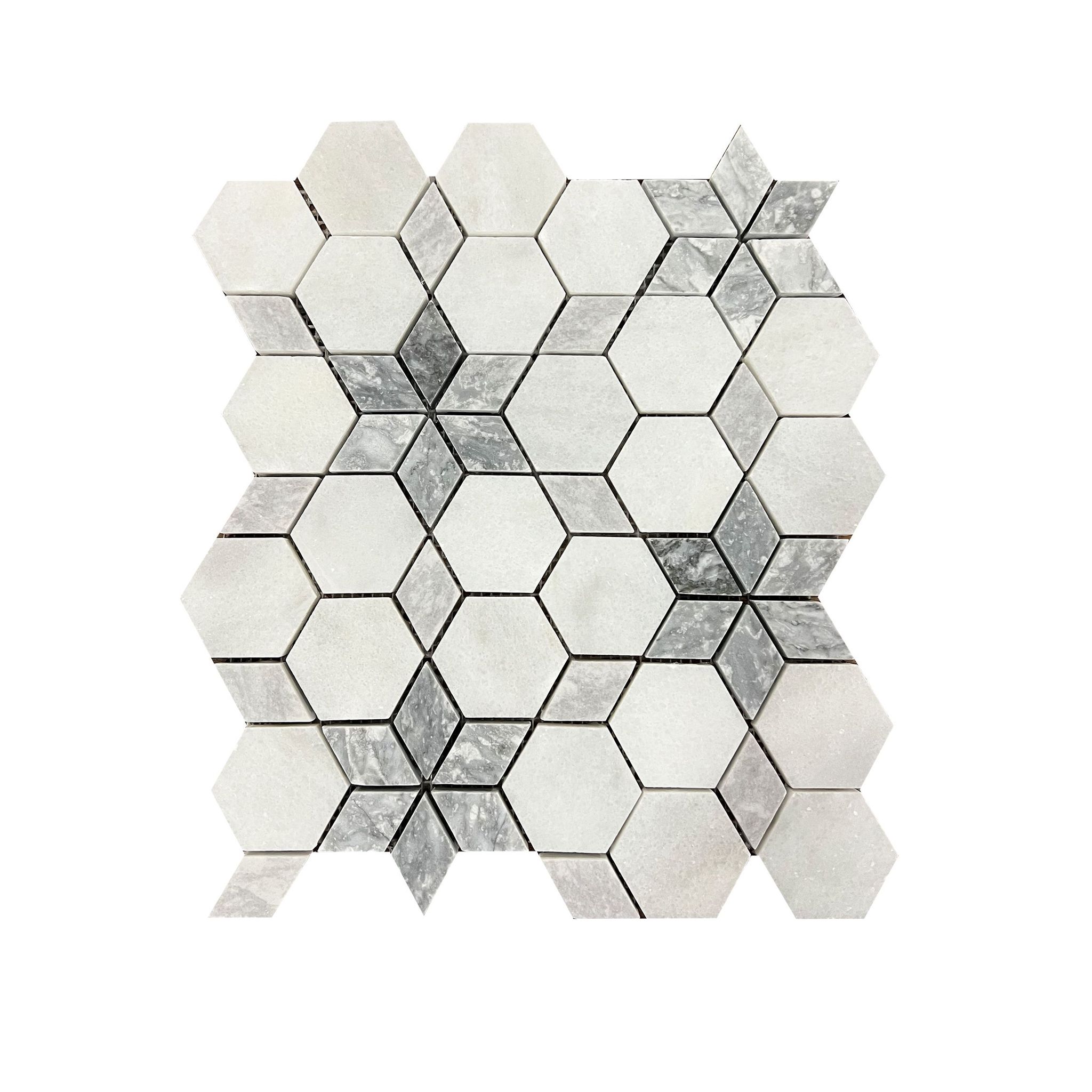
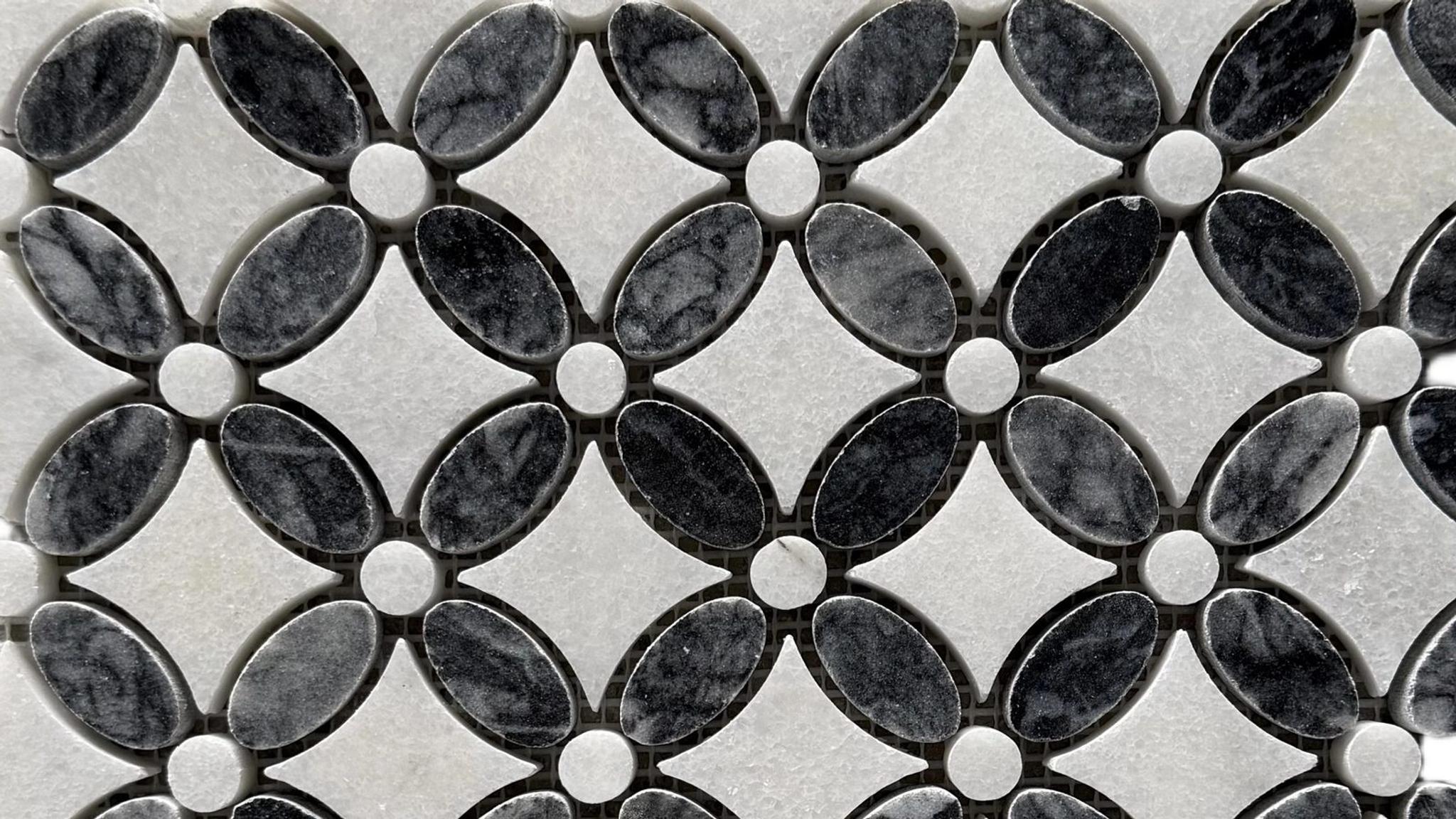
A waterjet mosaic is a stone mosaic whose pieces are cut by a computer-guided jet of water and abrasive instead of a saw. A saw cuts straight lines, so ordinary mosaics are built from squares, rectangles, hexagons and other straight-edged shapes. A waterjet can follow any line, so it can cut curves, petals, leaves, arabesques, letters and interlocking shapes, and cut two or more stones along the same path so that they fit together.
The pieces are assembled by hand into the pattern and mounted on mesh sheets, like any other mosaic, or made up into a single panel such as a medallion.
How does waterjet cutting work?
A pump pressurises water to roughly 30,000 to 90,000 psi (about 210 to 620 MPa) and forces it through a tiny nozzle. For stone, an abrasive, usually garnet, is fed into the stream. The machine moves the jet along a path drawn in a CAD file, and the jet wears its way through the stone.
- No heat: the water carries the heat away, so the stone is not scorched or stressed by heat.
- A narrow cut: an abrasive jet removes a line roughly 1 mm wide, which is what lets two stones cut on the same path sit close together.
- Any shape: curves and inside corners that a saw cannot reach are cut in one pass.
What can be made with a waterjet?
| Type | What it is | Typical use |
|---|---|---|
| Waterjet mosaic | A repeating pattern of shaped pieces, often in two or three stones, on mesh sheets | Walls, backsplashes, bathroom floors, feature panels |
| Medallion | A single centrepiece, round, square or oval, made of many cut pieces | Entrance halls, lobbies, the centre of a floor |
| Inlay and border | A band or motif cut into a field of plain tile or slab | Floor borders, thresholds, framed rugs of stone |
| Custom design | A logo, lettering or a design drawn for one project | Hotels, shops, restaurants, entrances |
Which stones and finishes work?
Most marbles, limestones and travertines can be cut by waterjet, and the strength of the technique is combining them: white and black marble, cream limestone with green or grey, honed beside polished. A few points shape the choice:
- Contrast: the pattern reads best when the stones differ clearly in colour or finish.
- Travertine: choose a filled travertine for small cut pieces, so holes do not open up at the edges.
- Polished pieces: fine for walls; on floors, especially wet ones, choose honed or tumbled stones.
- Green marble: many green marbles are serpentinite and need an epoxy adhesive, so check the whole design can be fixed the same way.
What makes a design work?
- Thin points and narrow strips are the weak spots: very fine tips and slivers can break in cutting, assembly or grouting, so they are thickened slightly or redrawn.
- Scale matters: a pattern that looks fine on screen can look busy on a wall. Print it at full size, or approve a sample sheet.
- Plan the edges: curved patterns do not end in a straight line, so decide where the field stops and how it is finished, with a cut piece, a stone border or a trim.
- Match thickness: a medallion or inlay must be the same thickness as the tile or stone around it, so the floor is flat.
How do you install a waterjet mosaic?
Mesh-mounted waterjet sheets are set like other stone mosaic sheets:
- A white, polymer-modified thin-set made for natural stone, so grey does not show through light marble.
- Full coverage under every piece; small pieces have little contact area, so bed them evenly and check that none is loose.
- Unsanded grout for the narrow joints of a waterjet pattern, and on polished stone, because sanded grout can scratch it.
- Seal honed and tumbled stones before grouting, so dark grout does not stain a light stone, then seal again once the grout has cured.
A medallion usually arrives as one assembled panel with a layout drawing. Set it first, at the right level, and lay the field tile around it.
Our guide to installing marble mosaic covers the steps in detail.
How do you care for a waterjet mosaic?
The same way as any marble, limestone or travertine: pH-neutral cleaners, no vinegar, lemon or acidic bathroom cleaners, and a penetrating sealer renewed when water stops beading. Where a design mixes polished and honed stones, one cleaning plan suits both.
See our guide to sealing and our guide to cleaning.
Why does waterjet mosaic cost more?
Because each sheet takes more work than a sawn mosaic. Price depends on:
- The length of cutting and the number of pieces in each sheet.
- How many stones are combined, since each is cut separately.
- Hand assembly, which takes longer for small and intricate pieces.
- Whether the design is a standard pattern or drawn for your project.
Compare quotes for the same design, stones, finish and sheet size.
Where do waterjet mosaics work best?
- Kitchen backsplashes and bathroom walls, where a pattern is seen close up.
- Feature walls and niches, framed by plain tile in one of the same stones.
- Entrance and lobby floors, as a medallion or a border in a field of plain stone.
- Shower floors, in honed or tumbled stones, where the many joints add grip.
For backsplashes, see our guide to mosaic backsplashes. For showers, see travertine, marble and limestone in showers.
Waterjet mosaics from our factory
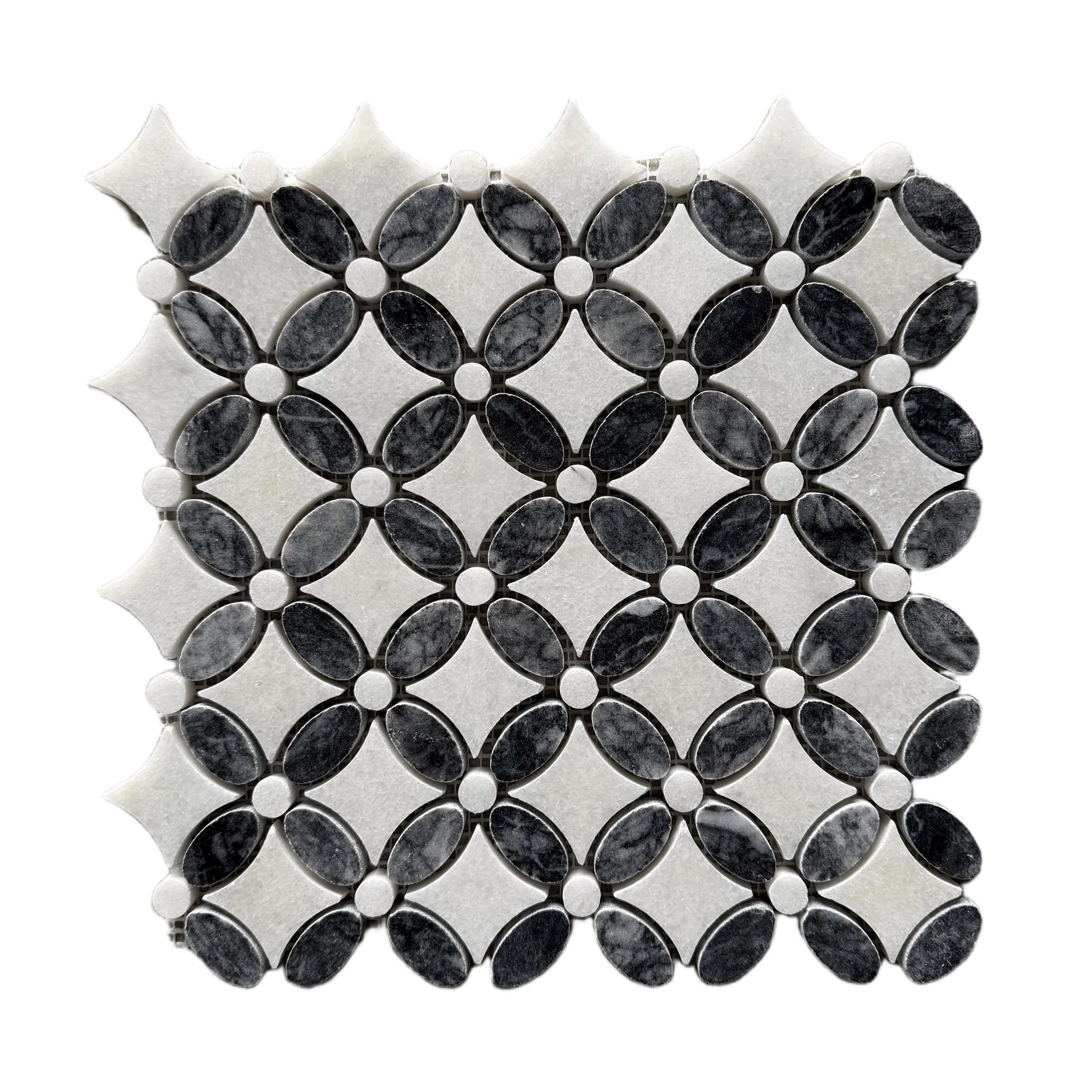
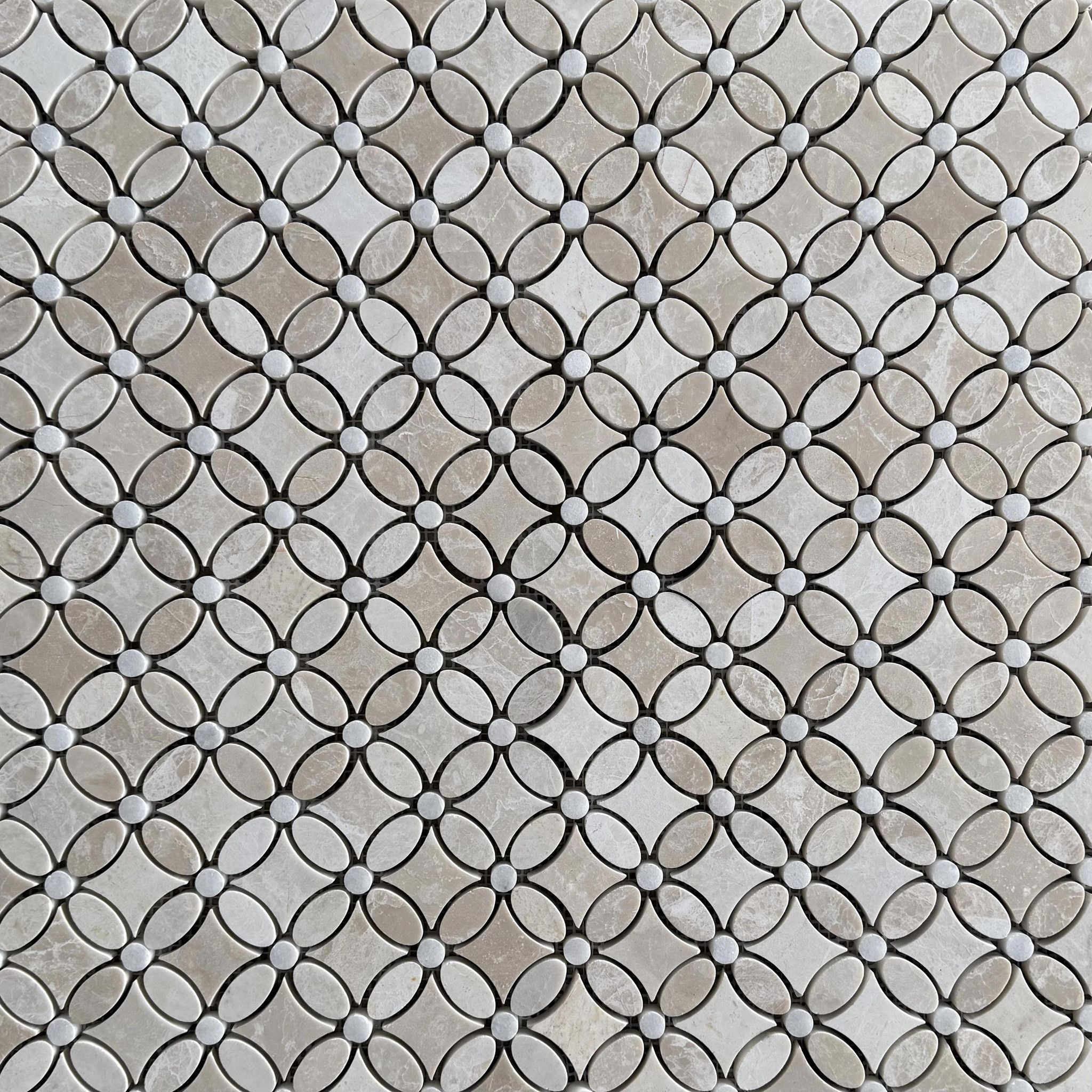
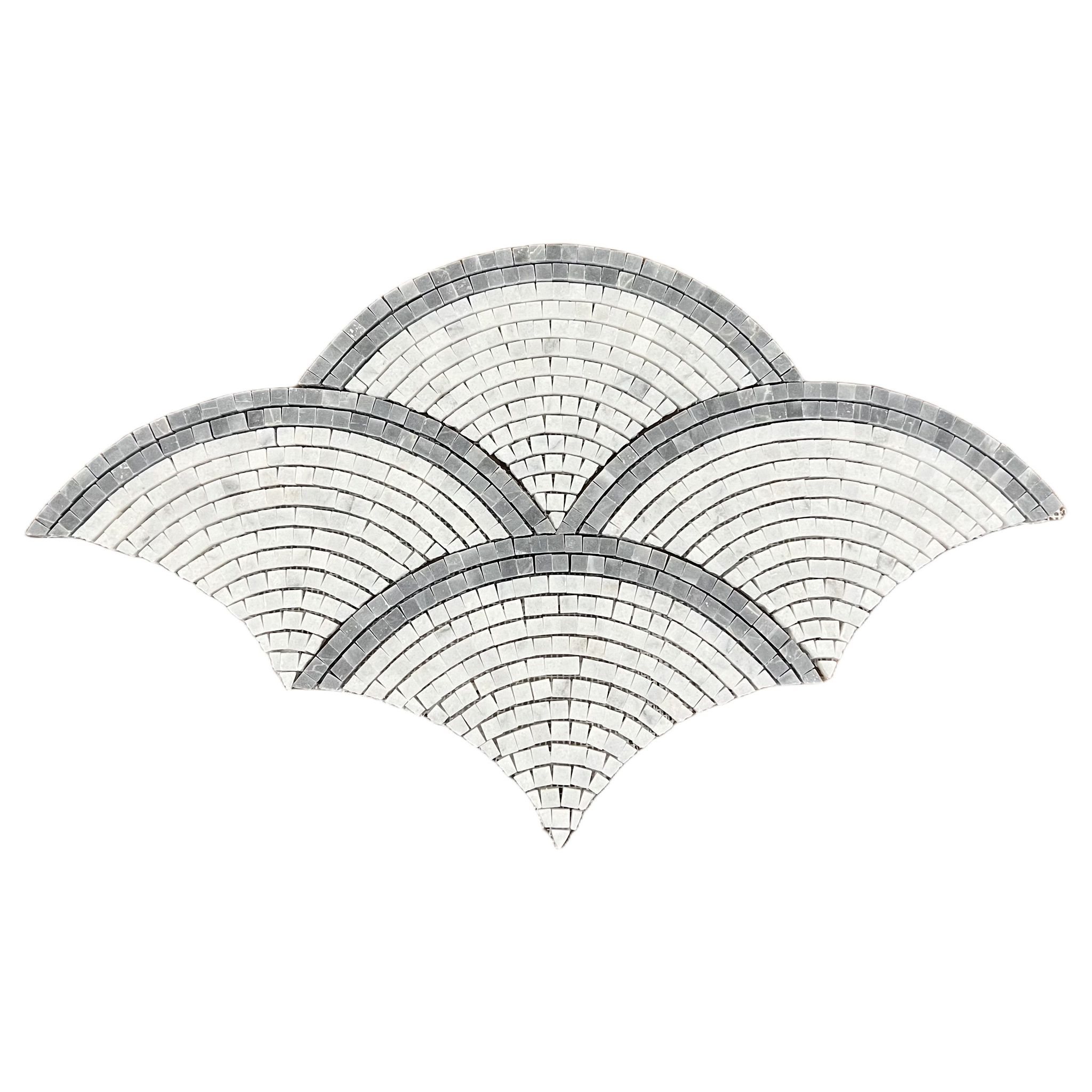
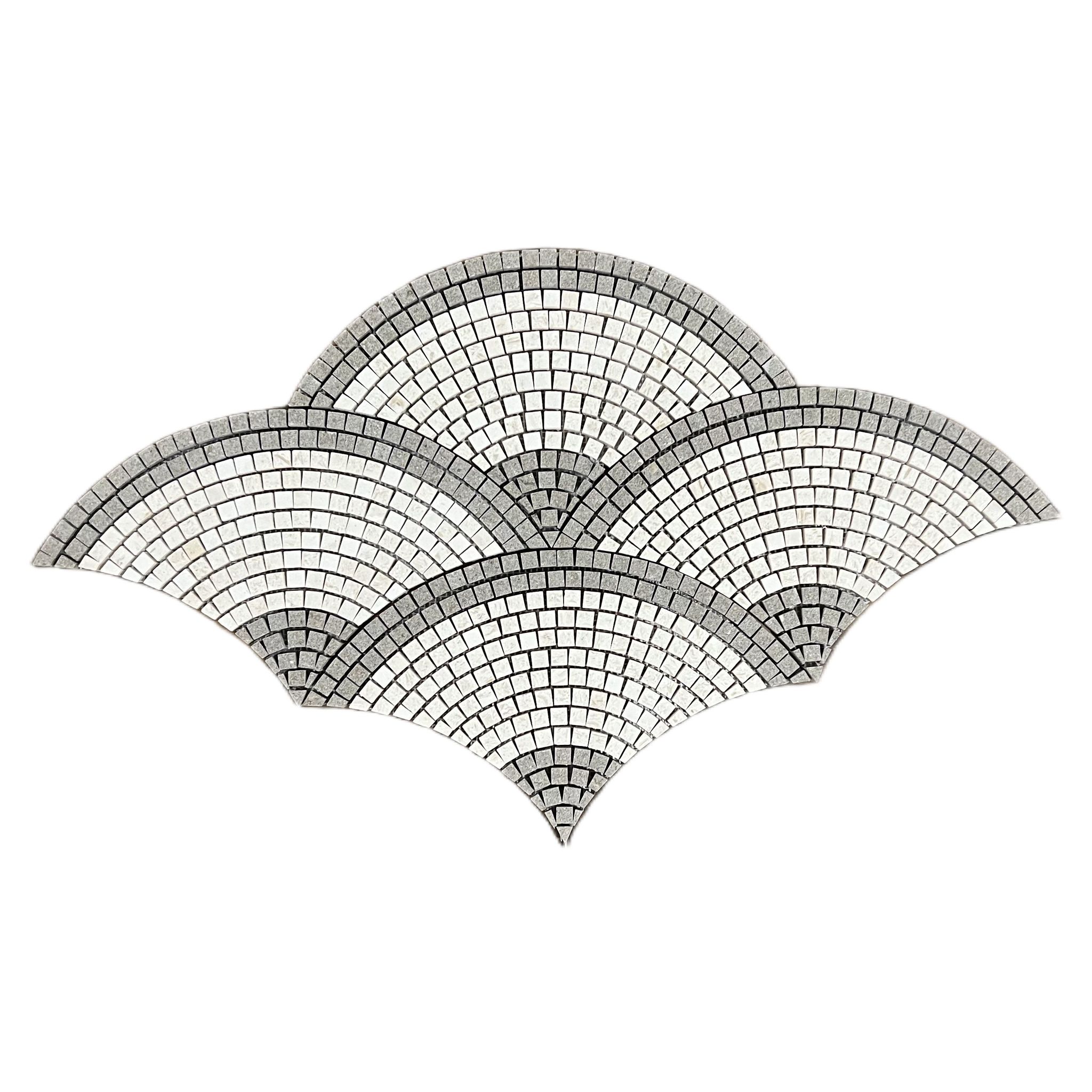
We cut waterjet mosaics and patterns in marble, limestone and travertine at our factory in Denizli, Türkiye, for wholesale and project orders, together with the matching plain tiles, borders and slabs. Send us a drawing, a CAD file or a photograph of the pattern you want, with the stones, finish, size and total area, and we will quote for your specification. See our flower mosaics and fan and scallop mosaics for patterned mosaics from past production, or all our marble mosaics.
Frequently asked questions
- What is a waterjet mosaic?
- A stone mosaic whose pieces are cut by a computer-guided jet of water and abrasive. Because a waterjet can cut curves, it makes patterns a saw cannot, such as flowers, leaves, arabesques and lettering, often combining two or more stones.
- How does a waterjet cut stone?
- Water is pressurised to roughly 30,000 to 90,000 psi, mixed with an abrasive such as garnet, and forced through a small nozzle that follows a path from a CAD file. It cuts without heat and removes a line about 1 mm wide.
- Can waterjet mosaic be used on floors?
- Yes, in honed or tumbled stones; polished pieces are slippery when wet. Bed every piece fully, grout with unsanded grout and seal the stone.
- What is the difference between a waterjet mosaic and a medallion?
- A waterjet mosaic is a repeating pattern on mesh sheets that covers an area. A medallion is a single centrepiece, cut and assembled as one panel, usually set into a floor of plain stone.
- Can you make a custom waterjet design or logo?
- Yes. A design is drawn as a CAD file and cut from the stones you choose. Approve a full-size print or sample first, because scale and contrast look different in stone than on screen.
- Which grout is best for waterjet mosaic?
- Unsanded grout, because waterjet joints are narrow and sanded grout can scratch polished stone. Seal honed and tumbled stones before grouting, especially with a contrasting grout.