
Limestone or marble — which should you specify?
The short version
Marble is limestone that heat and pressure have recrystallised into interlocking calcite crystals, so it is usually denser, absorbs less water and takes a high polish. Limestone is finer and more matte, often with fossils, and ranges far more widely from soft to dense. Both are calcium carbonate: both rate about 3 on the Mohs scale, both etch with acids and both need sealing.
What is the difference between limestone and marble?
Marble is limestone that has been changed by heat and pressure deep in the earth. Limestone forms in shallow seas, mostly from shell, coral and other debris made of calcite, and often still shows fossils. When limestone is buried and heated, its calcite recrystallises into a mass of interlocking crystals: that is marble. The process also blurs the fossils and layers of the original stone. Marble formed in the same way from dolostone, a close relative of limestone, is called dolomitic marble.
So the two are close relatives with the same main mineral, calcium carbonate. The difference is structure: limestone is a sedimentary stone with a finer, more open texture, and marble is a crystalline stone that is usually denser and takes a high polish.
One complication: the trade uses the word marble more loosely than geologists do. Any crystalline carbonate stone that takes a polish can be sold as marble, including some dense limestones. Judge the stone itself, not the name on the box. Our guide to Turkish and Italian marble explains why trade names are not proof of origin either.
How do limestone and marble compare?
| Feature | Limestone | Marble |
|---|---|---|
| How it forms | Builds up in shallow seas from shell and coral debris | Limestone recrystallised by heat and pressure |
| Look | Fine-grained and even, often matte; fossils or shell fragments in some stones | Crystalline, often veined, with depth when polished |
| Usual finishes | Honed, brushed, tumbled; a few dense limestones take a polish | Polished, honed, tumbled, brushed |
| Water absorption limit in the US specification | Up to 3%, 7.5% or 12% by weight, depending on density class (ASTM C568) | Up to 0.20% by weight (ASTM C503) |
| Hardness | Mostly calcite: about 3 on the Mohs scale | Mostly calcite: about 3 on the Mohs scale |
| Reaction to acids | Etches | Etches |
The absorption figures are the maximum each specification allows, not typical values. A dense limestone can absorb far less than its class limit, so compare the two actual stones.
Is limestone more porous than marble?
Usually, yes. Recrystallisation closes up the pore structure, which is why the US marble specification allows only 0.20% absorption while even its densest limestone class allows up to 3%. But limestone covers a very wide range, from soft, open stones to dense ones that behave much like marble. The higher the absorption, the more a stone needs sealing in wet areas and the more it matters in frost, because water expands by about 9% when it freezes.
Is marble harder or more durable than limestone?
Not in mineral terms. Both are made mostly of calcite, which is 3 on the Mohs scale, so both scratch more easily than granite or porcelain, and both etch with acids. What usually makes marble the more forgiving of the two is its lower porosity, not hardness.
Durability on site depends more on the particular stone, the finish and the use than on the category. A dense limestone can outlast a soft marble on a busy floor. For heavy traffic, choose a dense stone in a honed or brushed finish, which hides wear better than polished.
Which is better for floors?
- Calm, even interiors: limestone gives a quiet, matte surface with little pattern.
- Veined or polished looks: marble, which is the stone to choose when shine and depth are the point.
- Busy floors: either, in a dense stone. Polished marble shows scratches and etching most; honed or brushed hides them.
Comparing finishes as well? See our guide to stone finishes.
Settled on marble? See the pros and cons of marble tile room by room.
Which is better in bathrooms?
Both are used in bathrooms. Marble's lower absorption makes it the more forgiving choice in wet areas; limestone works well too if you choose a dense one and seal it. Whichever you choose, floors in wet areas need a finish with grip, and both stones must be cleaned with pH-neutral products only.
Planning a shower? See travertine, marble and limestone in showers.
Which is better outdoors and around pools?
Both can be used outside, and the choice depends on the climate and the particular stone more than on the name.
- Frost: choose a dense, low-absorption stone and a base that drains. Soft, open limestones are the riskiest choice in hard frost.
- Grip: use a tumbled, brushed or honed finish on wet areas, never polished.
- Heat: paler stone usually stays cooler in direct sun.
- Sealing: agree a breathable exterior sealer and a maintenance plan, especially around salt-water pools.
Considering travertine too? See marble or travertine.
For travertine against limestone, see travertine or limestone.
Is limestone cheaper than marble?
Not as a rule. Price depends on the particular stone, the grade, the format and the finish, and both families run from everyday stones to rare ones. A common marble can cost less than a sought-after limestone. Compare quotes for the same size, thickness and finish, and compare the landed cost.
How can you tell limestone and marble apart?
- Look at a freshly cut or broken edge: marble shows interlocking crystals, while limestone looks fine-grained and earthy.
- Look for fossils and shell fragments: they are common in limestone and are usually blurred or gone in marble.
- Look for veining: it is typical of marble, though not universal.
An acid test does not separate them: both react with acid. Never test a finished piece with vinegar or lemon, because it will etch the surface.
Can limestone and marble be used together?
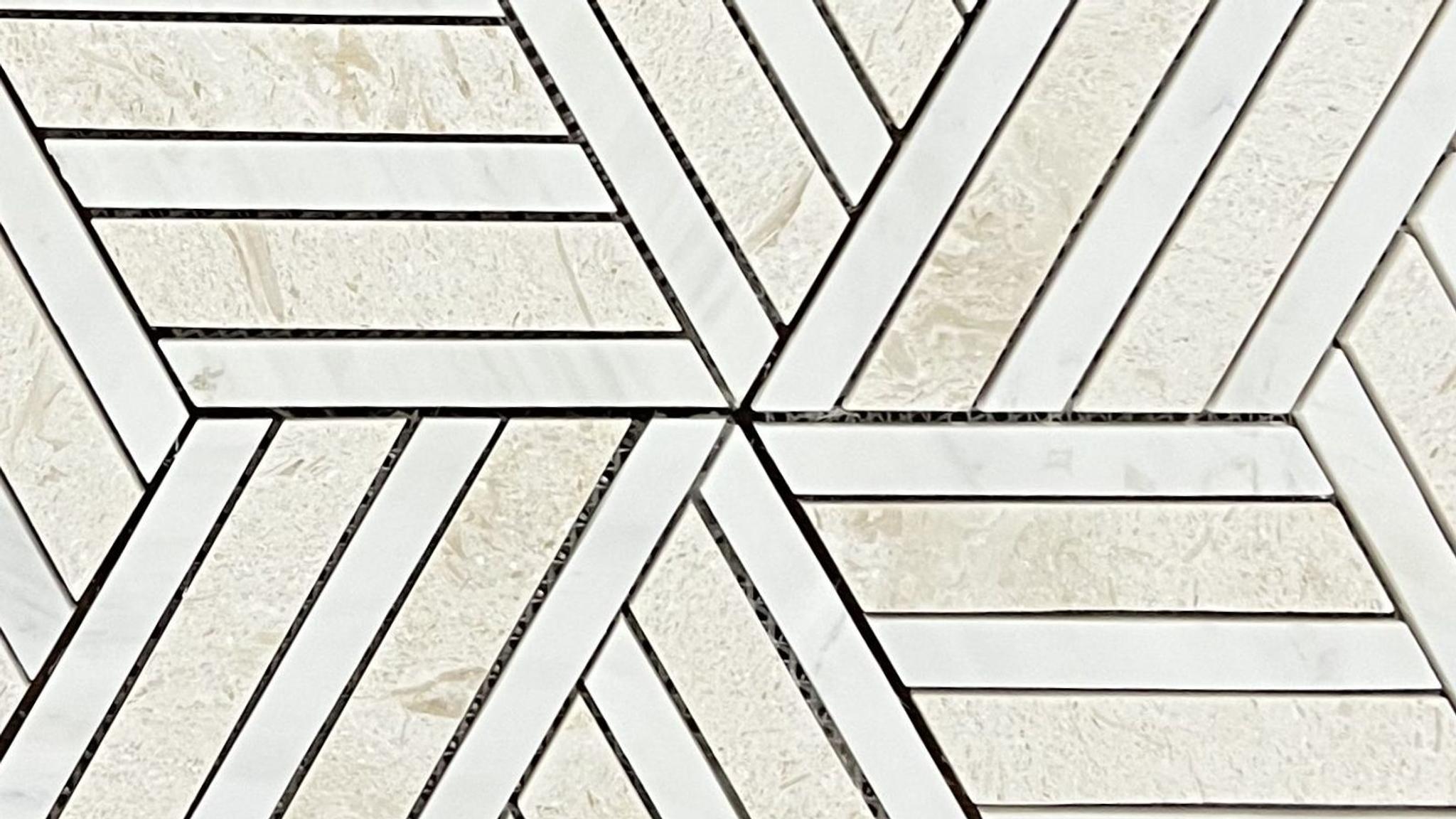
Yes. They are often combined in mosaics and patterned floors, where the matte limestone sets off the veined marble. Both need the same care, so one cleaning and sealing plan covers the whole surface. Check that both stones suit the location, and approve the combination on a sample.
For sealing, see our guide to sealing.
For everyday care, stains and etch marks, see our guide to cleaning.
Limestone and marble from our factory
We produce marble and limestone tiles and mosaics at our factory in Denizli, Türkiye, for wholesale and project orders, and we combine the two in one design. Tell us the stone, size, finish and total quantity, and we will quote for your specification. See Turkish limestone for examples of past production.
Sourcing marble? See marble from Turkey.
Frequently asked questions
- Is marble harder than limestone?
- Not really. Both are made mostly of calcite, which is 3 on the Mohs scale. Marble is usually denser and less porous, which makes it more forgiving, but a dense limestone can wear as well as a soft marble.
- Is limestone more porous than marble?
- Usually. The US marble specification, ASTM C503, allows at most 0.20% water absorption, while the limestone specification, ASTM C568, allows 3% to 12% depending on density. Dense limestones can absorb far less than those limits, so compare the actual stones.
- Is limestone cheaper than marble?
- Not as a rule. Both range from everyday to rare stones, so compare quotes for the same size, thickness and finish.
- Can limestone be polished like marble?
- Some dense limestones take a polish, and the trade often sells them as marble. Most limestone is honed, brushed or tumbled.
- Is limestone or marble better for a bathroom?
- Both work. Marble absorbs less, so it is the more forgiving choice in wet areas. Choose a dense limestone if you prefer its look, use a finish with grip on the floor, seal either stone and clean it with pH-neutral products.
- Do limestone and marble both etch?
- Yes. Both are calcium carbonate, so vinegar, lemon juice and acidic cleaners etch both. Sealing slows staining but does not stop etching.
Sources
- Geology.com, Marble: metamorphic rock
- Geology.com, Limestone: sedimentary rock
- ASTM C568/C568M, Standard Specification for Limestone Dimension Stone
- ASTM C503/C503M, Standard Specification for Marble Dimension Stone (absorption limit as given in the 2010 edition)