
Travertine or porcelain pavers — which should you specify?
The short version
Travertine pavers are natural stone, usually about 30 mm thick, with a surface that varies piece to piece and is usually sealed. Porcelain pavers are fired ceramic, usually about 20 mm thick, absorb 0.5% or less and need little upkeep. Choose travertine for natural variation and a surface that can be refinished, porcelain for uniformity, hard frost and low upkeep.
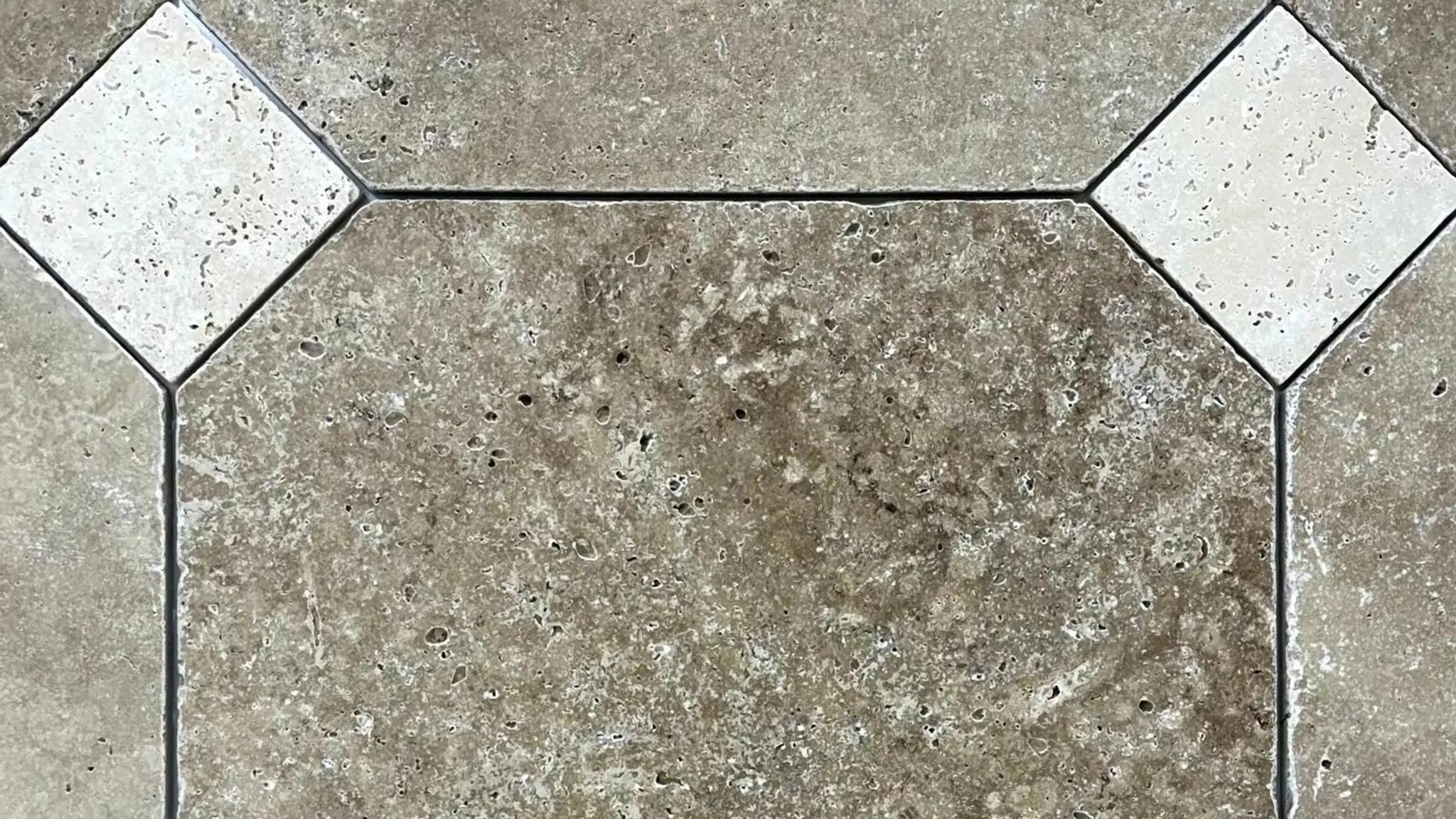
What is the difference between travertine and porcelain pavers?
Travertine is natural stone. It is a form of limestone laid down by mineral springs, quarried in blocks and cut into pavers. Porcelain is a manufactured ceramic: clay and minerals pressed into shape and fired at high temperature until almost no water can enter.
A tile counts as porcelain when it absorbs 0.5% of its weight in water or less. That is the threshold in the US standard ANSI A137.1 and in group BIa of the international standard ISO 13006. Many stone-look porcelain pavers carry a printed image of stone on their surface.
How do travertine and porcelain pavers compare?
| Feature | Travertine pavers | Porcelain pavers |
|---|---|---|
| Material | Natural stone, cut from blocks | Manufactured ceramic, pressed and fired |
| Look | Every piece differs, and the colour runs through the stone | Even and repeatable; stone looks are printed on the surface |
| Usual outdoor thickness | About 30 mm | About 20 mm |
| Water absorption | Varies by stone, so it is usually sealed | 0.5% or less, so it is usually not sealed |
| Surface | Tumbled, brushed or honed; holes filled or open | Textured outdoor finishes made in the factory |
| Chips and wear | The same stone below the surface, so marks blend in | On some products a chip shows a different body colour |
| Refinishing later | Can be cleaned back, honed and re-sealed | The surface cannot be refinished |
Which is better around a pool?
Both are used around pools, and the right choice depends on the site and on how much upkeep the owner will accept. Check these points.
- Grip when wet: choose a tumbled or brushed travertine, or a porcelain with a textured outdoor finish. Avoid polished surfaces on any wet floor.
- Heat in the sun: paler colours stay cooler with either material. Travertine has a reputation for staying cool underfoot, but we did not find an independent comparison that settles it.
- Pool water: travertine needs a sealer suited to chlorine or salt water and regular upkeep. Porcelain is far less affected because it hardly absorbs water.
- Edges: pool coping is a separate item. Specify its profile, thickness and length with the deck, so the edge matches the paving.
Unfilled travertine drains through its open holes, and filled travertine gives a closed surface. See our guide to filled and unfilled travertine for that decision.
Which handles frost better?
Porcelain usually does. Its very low absorption leaves little water inside the paver to freeze. Travertine varies from stone to stone, so in a climate with hard frost choose a dense stone, seal it, and lay it on a base that drains.
In a mild climate, frost does not decide the matter, and the choice comes down to look, comfort underfoot and upkeep.
What does each cost?
It depends on the grade, format, thickness and finish, and neither is always cheaper. Compare quotes for the same size and thickness, and compare the installed cost, not the price per square metre alone: the base, the laying, sealing and upkeep over the years all count.
Importers should also check freight. A 30 mm stone paver weighs more per square metre than a 20 mm porcelain paver, so a container of stone pavers reaches its weight limit with fewer square metres. Ask your forwarder how the load will be planned.
Which should you choose for your project?
- Natural variation and a surface that ages with the site: travertine.
- A uniform look across a very large area: porcelain.
- Hard frost and minimal upkeep: porcelain, or a dense stone chosen with care.
- Resort, Mediterranean and heritage designs: travertine, often in a French pattern.
- Roof terraces where load matters: the thinner, lighter porcelain paver may suit. Ask your engineer.
Planning a multi-size layout? See our guide to French pattern travertine.
Comparing tiles for indoors? See marble or porcelain tile.
How should you write a paver order?
- Material, product name and the approved sample reference
- Length, width and thickness in millimetres
- Finish and edge detail, such as tumbled or chiselled
- For travertine: filled or unfilled, and the sealer
- Total area, plus the allowance for cuts agreed with your installer
- Packing, and the weight of each crate
Travertine pavers from our factory
We produce travertine pavers and French pattern sets in the size you specify at our factory in Denizli, Türkiye, for wholesale and project orders. Tell us the stone, size, thickness, finish and total area, and we will quote for your specification. See our pavers for examples of past production.
Frequently asked questions
- Is porcelain better than travertine for a pool deck?
- Neither by default. Porcelain needs less upkeep and handles frost well. Travertine gives natural variation and grip when it is tumbled or brushed, but it needs sealing. Choose by climate, look and the upkeep the owner will accept.
- Does travertine need sealing outdoors?
- Usually, yes. Use a sealer suited to the location, and to the pool water around a pool, and reapply it as the sealer maker advises.
- Is porcelain cheaper than travertine?
- Not always. Price depends on the grade, format, thickness and finish. Compare the installed cost of the same specification, including the base, sealing and upkeep.
- Can porcelain look like travertine?
- Yes. Many porcelain pavers are printed with an image of travertine. The design repeats across a large area, while every piece of real travertine is different.
- Which stays cooler in the sun?
- Colour matters most with either material: paler pavers stay cooler. Travertine is often said to stay cooler, but we did not find an independent comparison.
Sources
- ANSI Blog, Porcelain ceramic tile: the ANSI A137.1 and ASTM definition
- ISO 13006 (EN 14411), Ceramic tiles: definitions, classification, characteristics and marking
- ASTM C1527/C1527M, Standard Specification for Travertine Dimension Stone