
Marble or porcelain tile — which should you specify?
The short version
Porcelain is a fired tile that absorbs 0.5% of its water weight or less, resists scratches and everyday acids and needs little care, but a worn or chipped glaze cannot be refinished. Marble is natural stone that absorbs as little (its US specification allows at most 0.20%), but acids etch it and it scratches more easily, so it is sealed; in return it has real depth and veining, and it can be re-honed and re-polished instead of replaced.
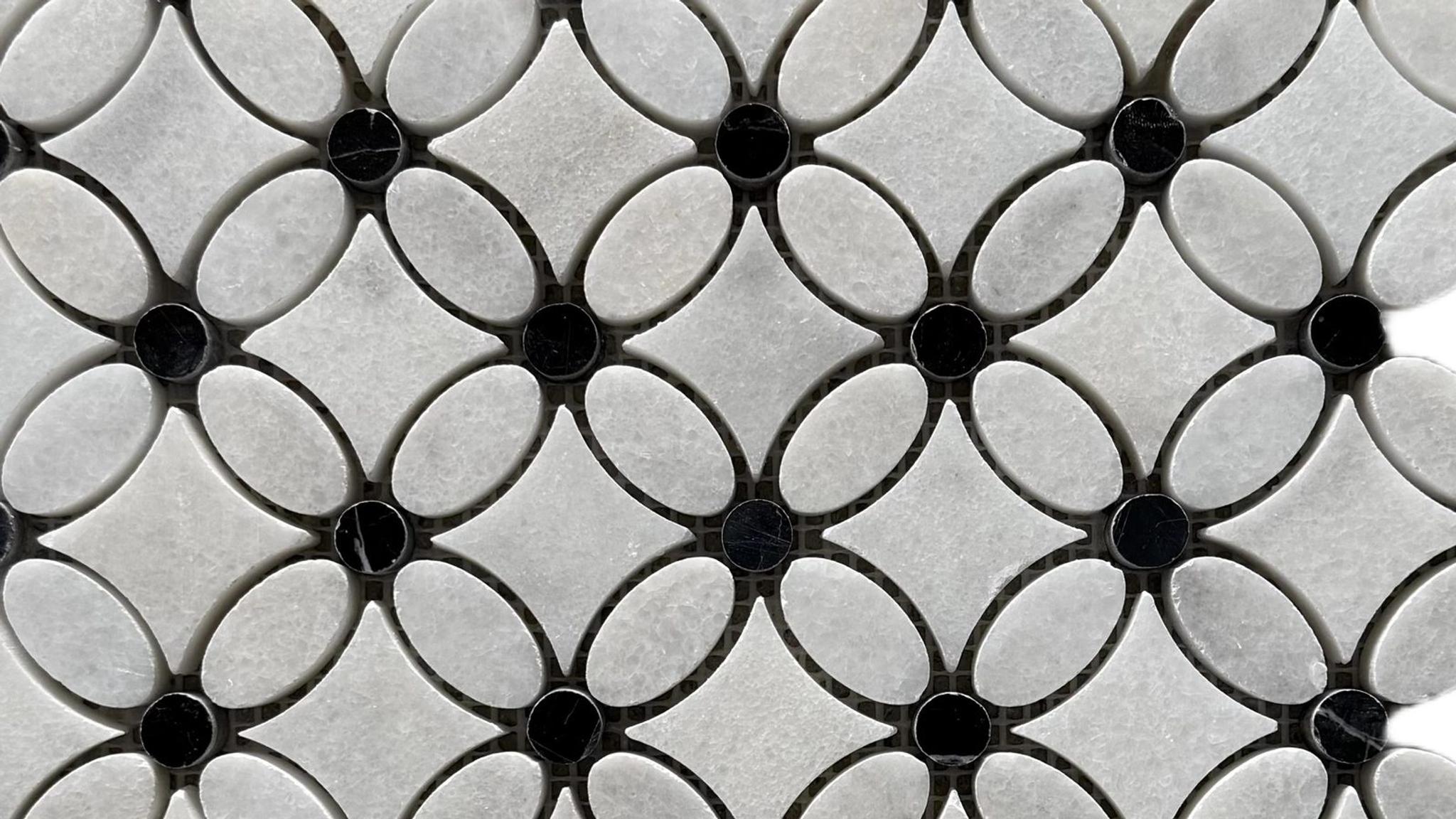
What is the difference between marble and porcelain tile?
Marble is a natural stone: limestone that heat and pressure have recrystallised into a dense mass of calcite crystals, quarried in blocks and cut into tiles and mosaics. Porcelain is a manufactured tile: a clay body pressed and fired at high temperature until it absorbs 0.5% of its weight in water or less, which is the definition in the US standard ANSI A137.1 and in group BIa of ISO 13006.
A marble-look porcelain tile is porcelain with a picture of marble on its surface. On most of them the design sits in the glaze; the body underneath is a plain colour.
How do marble and porcelain compare?
| Feature | Marble | Porcelain |
|---|---|---|
| What it is | Natural stone, mostly calcite | Fired clay body, usually glazed |
| Look | Veining and colour run through the stone; every piece differs | A printed or pressed design, usually only in the glaze |
| Water absorption limit in its standard | At most 0.20% by weight (ASTM C503) | 0.5% or less by weight (ANSI A137.1, ISO 13006 BIa) |
| Acids (lemon, vinegar, wine) | Etch the surface, sealed or not | Everyday spills do not etch it |
| Scratches | Softer: about 3 on the Mohs scale | Harder surface, scratches far less |
| Sealing | Yes, with a penetrating sealer | Usually not; the grout may be sealed |
| Wear and repair | Can be re-honed and re-polished in place | A worn or chipped glaze cannot be refinished; the tile is replaced |
| A chip shows | More of the same stone | The body, which on glazed tile does not carry the design |
| Finishes | Polished, honed, tumbled, brushed | Polished, matte, textured |
Does marble absorb more water than porcelain?
Not necessarily, which surprises many buyers. The US marble specification allows marble to absorb at most 0.20% of its weight, below the 0.5% that defines porcelain. Both are low. Marble's weakness is not water but acid: calcite reacts with acids, so lemon, vinegar, wine and acidic cleaners leave dull etch marks, and oils and coloured liquids can stain it if they sit. That is why marble is sealed and cleaned with pH-neutral products, and porcelain usually is not.
Is porcelain more durable than marble?
In the sense of needing less care, yes. Its surface resists scratching and everyday acids far better, so a porcelain floor looks much the same after years of use. Marble wears: it gathers fine scratches, etch marks and a softer sheen.
The difference is what happens next. A marble floor can be deep-cleaned, re-honed and re-polished by a stone restorer, as often as it needs, because the stone is the same all the way through. Porcelain cannot be refinished: when the glaze wears through or chips, the printed design is gone at that spot and the tile has to be cut out and replaced, with a matching tile from the same batch if one can still be found.
Which is better for floors?
- Heavy commercial traffic with minimal upkeep: porcelain.
- Living areas, hallways, hotel lobbies and bathrooms where the look of real stone matters: marble, honed rather than polished on busy floors, because honed hides scratches and etching.
- Wet floors: neither in a polished finish. Choose honed or tumbled marble, or a matte or textured porcelain, and check the wet slip value; in the US the benchmark for level interior floors walked on when wet is a wet DCOF of at least 0.42 (ANSI A326.3).
For finishes side by side, see our guide to stone finishes.
Marble or porcelain in a shower or bathroom?
Both work. Porcelain is the lower-maintenance choice. Marble needs sealing, pH-neutral cleaners and no acidic limescale removers, but it gives a bathroom real stone, and as a honed or tumbled mosaic on the shower floor its many joints add grip. Light marble is fixed with a white adhesive; many green marbles need an epoxy one. See travertine, marble and limestone in showers.
Marble-look porcelain or real marble?
Marble-look porcelain has improved a great deal, and from a distance it can be convincing. The differences show close up and over time:
- Depth: real marble has translucency and crystals; a printed design is a flat image.
- Repeats: a printed range is made from a limited set of designs, so the same veins can recur across a large floor.
- Edges and chips: on marble the veining runs through the piece; on glazed porcelain a chip or a cut edge shows the plain body.
- Formats: marble can be cut into mosaics of any shape and tumbled or brushed; porcelain comes in the formats a factory presses.
Porcelain wins on upkeep and consistency from tile to tile. Marble wins on depth, variety and the fact that it can be restored rather than replaced.
Is porcelain cheaper than marble?
Often, but not as a rule. Both run from everyday to premium, and a high-end porcelain can cost more than a common marble. Compare the installed cost for the same format and finish, and add the upkeep: marble needs a sealer and pH-neutral cleaning over the years, porcelain much less.
Marble or porcelain for kitchens?
On floors, porcelain shrugs off spills; marble needs sealing and quick wiping of acids, and a honed finish. On walls, a marble backsplash is easy to live with because nobody walks on it; see our guide to mosaic backsplashes. For worktops, see our guide to marble countertops.
So which should you specify?
- Porcelain: the lowest upkeep, heavy traffic, uniform colour from tile to tile, and owners who will not reseal.
- Marble: real stone, veining that runs through the piece, mosaics and patterns in any shape, and a surface that can be restored for decades.
For marble's strengths and weaknesses in more detail, see the pros and cons of marble tile. For paving, see travertine or porcelain pavers.
Choosing between stones? See limestone or marble and marble or travertine.
Marble from our factory
We produce marble tiles and mosaics, and cut marble slabs, at our factory in Denizli, Türkiye, in polished, honed, tumbled and brushed finishes, for wholesale and project orders. Tell us the stone, format, finish and total area, and we will quote for your specification. See marble mosaics and marble from Turkey for examples of past production.
For sealing and everyday care, see our guide to sealing and our guide to cleaning.
Frequently asked questions
- Is porcelain better than marble?
- For low upkeep, yes: porcelain resists scratches and everyday acids and does not need sealing. Marble is better for the look and depth of real stone, mosaics in any shape, and a surface that can be re-honed and re-polished instead of replaced.
- Is marble more porous than porcelain?
- Not necessarily. The US marble specification allows at most 0.20% water absorption, below the 0.5% that defines porcelain. Marble's weakness is acid, not water: lemon, vinegar and wine etch it.
- Is porcelain tile cheaper than marble?
- Often, but not always. Both range from everyday to premium. Compare the installed cost for the same format and finish, and include marble's sealing and care.
- Marble or porcelain in a shower?
- Both work. Porcelain needs less care. Marble needs sealing and pH-neutral cleaning, and should be honed or tumbled on the floor, ideally as a mosaic.
- Does porcelain need sealing?
- Usually not, because it absorbs 0.5% of its weight in water or less. The grout may be sealed. Marble is sealed with a penetrating sealer.
- How can you tell marble-look porcelain from real marble?
- Look at a cut edge or a chip: on glazed porcelain the body underneath is plain, while marble is the same stone all the way through. Over a large floor, printed designs also repeat.
Sources
- ANSI Blog, Porcelain ceramic tile: the ANSI A137.1 and ASTM definition
- ISO 13006 (EN 14411), Ceramic tiles: definitions, classification, characteristics and marking
- ASTM C503/C503M, Standard Specification for Marble Dimension Stone (absorption limit as given in the 2010 edition)
- Marazzi USA, Frequently asked questions (glazed, colour-body and through-body porcelain)
- Geology.com, Marble: metamorphic rock
- Crossville, Wet DCOF and safety considerations (ANSI A326.3)
- Natural Stone Institute, Care and cleaning of natural stone