Natural stone tile sizes and thickness — what to specify
The short version
Natural stone tile has no single standard size. Inch markets use 305 x 305 mm and 610 x 305 mm, metric markets use 600 x 600 mm and 1200 x 600 mm, and most tile is 10, 12, 20 or 30 mm thick. Stone is cut to order, so write the exact size, thickness and tolerances in millimetres on the order.
What are the standard sizes for natural stone tile?
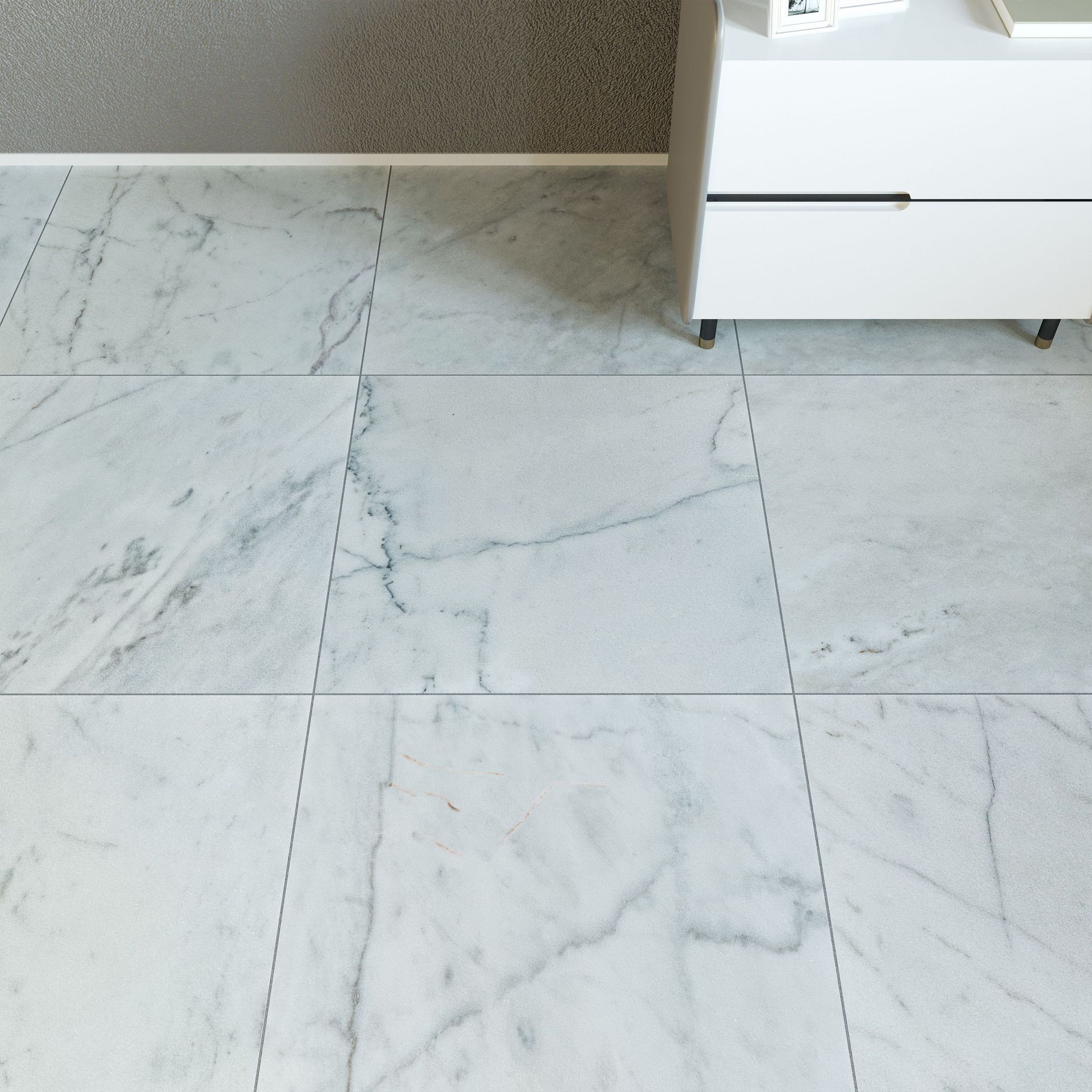
Natural stone has no single standard size. Two families dominate the trade: inch-based sizes such as 305 x 305 mm (12 x 12 in) and 610 x 305 mm (24 x 12 in), and metric sizes such as 600 x 600 mm and 1200 x 600 mm.
Stone is cut to order, so these are habits of the market and not limits of the material. The table shows common formats as a starting point for a specification. Any other size can be cut.
| Format | Size (mm) | Size (in) | Thickness (mm) |
|---|---|---|---|
| Small square | 100 x 100 | about 4 x 4 | 10 |
| Narrow strip | 305 x 100 | about 12 x 4 | 10 |
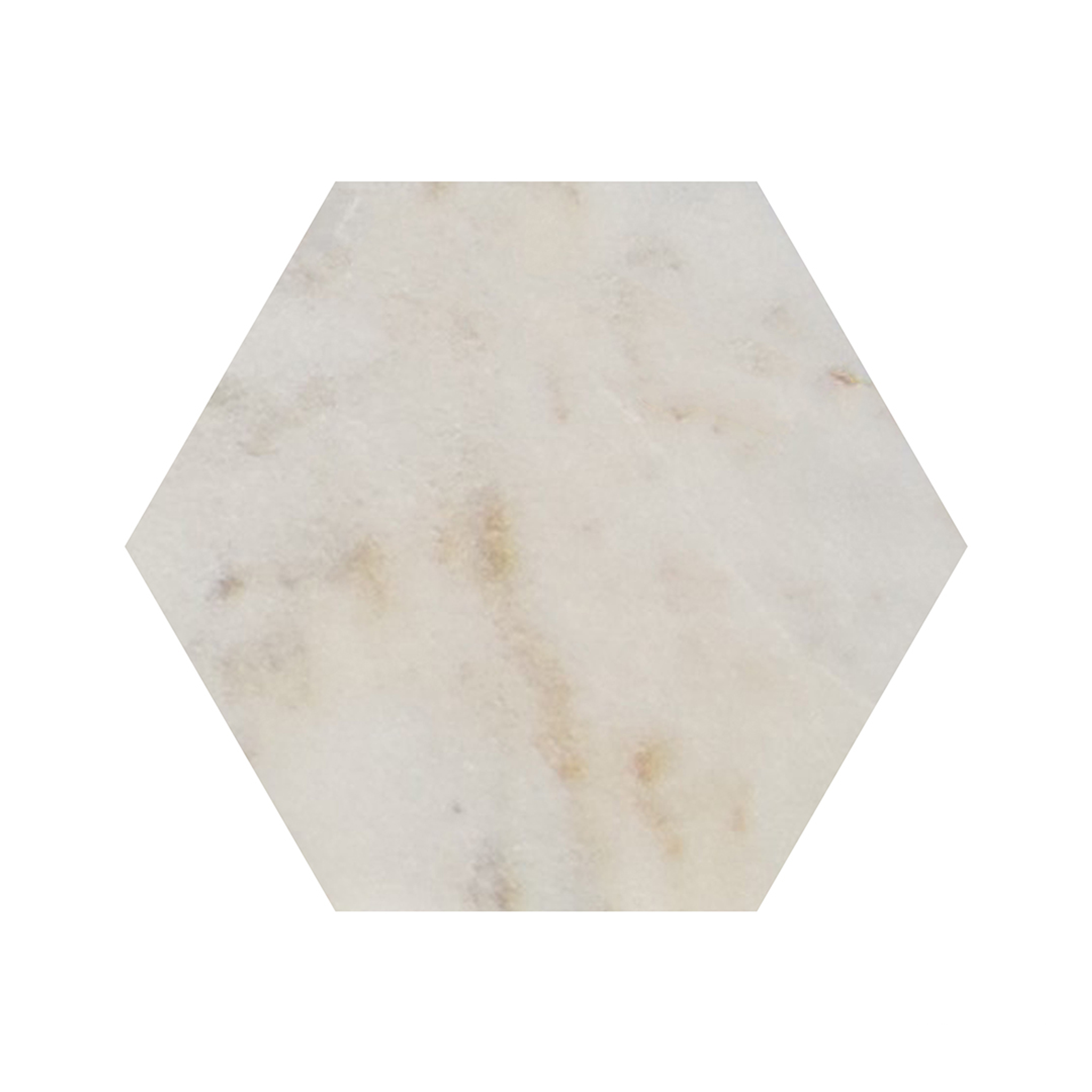
| Hexagon | 203 x 176 | about 8 x 7 | 10 |
| Inch square | 305 x 305 | 12 x 12 | 10, 12 |
| Inch square | 406 x 406 | 16 x 16 | 12 |
| Inch square | 457 x 457 | 18 x 18 | 10 |
| Inch rectangle | 610 x 305 | 24 x 12 | 10, 12 |
| Inch square | 610 x 610 | 24 x 24 | 10, 12, 20 |
| Inch large format | 1220 x 610 | 48 x 24 | 10, 12 |
| Inch large format | 914 x 914 | 36 x 36 | 20 |
| Metric square | 600 x 600 | about 24 x 24 | 20 |
| Metric square | 800 x 800 | about 32 x 32 | 20 |
| Metric large format | 1200 x 600 | about 47 x 24 | 20 |
Is a 600 mm tile the same as a 24 inch tile?
No. A 24 inch tile measures about 610 mm, so it is 10 mm longer on each side. Ten tiles in a row differ by about 100 mm, which is enough to change the layout, the cuts and the quantity.
Keep to one system across a project. A US drawing usually assumes inch sizes, and a European drawing usually assumes metric ones. Write the size in millimetres on the order, even when the drawing uses inches, so that nobody has to convert it.
How thick should natural stone tile be?
Most tile in the trade is 10, 12, 20 or 30 mm thick. Thickness depends on the use, the format and the stone. Trade guides do not fully agree, so treat this table as a starting point and confirm the choice with your installer or engineer.
| Thickness | Inches | Common use |
|---|---|---|
| 10 mm | about 3/8 | Interior walls, and interior floors in small formats |
| 12 mm | about 1/2 | Interior floors and walls |
| 20 mm | about 3/4 | Large formats, heavier interior floors, and many exterior floors |
| 30 mm | about 1 1/4 | Paving and exterior areas with more load |
Three things push the thickness up: a larger format, more load, and freeze and thaw outdoors. A soft or veined stone also needs more care than a dense one in the same size. For large formats and heavy loads, ask your engineer to check the thickness against the stone, the size and the fixing method.
What do EN 12057 and EN 12058 mean for size?
Europe splits this product into two standards. EN 12057 covers modular tiles for floors, stairs, walls and ceilings. EN 12058 covers slabs for floors and stairs.
Stone Specialist, a UK trade magazine, summarises the split this way: tiles are 12 mm or less in thickness and no more than 610 mm along any side, and slabs are thicker than 12 mm. So a 610 x 610 x 12 mm tile and a 610 x 610 x 20 mm piece can fall under different standards, with different tolerances.
The size and the thickness therefore decide which document applies. Check the current edition of the standard, and agree with your supplier which one the order follows. Tolerances should be written down at the same stage, for length, width, thickness and squareness.
How big is a mosaic sheet?
A mosaic sheet is often sold as 12 x 12 inches, but the real size depends on the pattern. Whole pieces have to fit on the sheet, so the edges rarely land on a round number.
| Sheet (mm) | Area per sheet | Sheets per m² |
|---|---|---|
| 305 x 305 | 0.093 m² | 10.8 |
| 290 x 290 | 0.084 m² | 11.9 |
| 284 x 299 | 0.085 m² | 11.8 |
| 266 x 266 | 0.071 m² | 14.1 |
| 265 x 305 | 0.081 m² | 12.4 |
The difference is real money on a large order. A 265 x 305 mm sheet covers about 13% less than a 305 x 305 mm sheet, so the same number of sheets will not finish the same floor. Calculate coverage from the actual sheet size, and add the cutting allowance your installer recommends.
Many mosaics are 10 mm thick. If a mosaic meets a 12 mm tile on the same floor, the two surfaces need to be levelled on site, so tell your installer about the difference before work starts.
Hexagon sheets are a common case of an uneven sheet size. See hexagon mosaics for examples.
How is a hexagon tile measured?
A hexagon has two widths, so one number is not enough. A tile sold as 8 inches measures about 203 mm from corner to corner and about 176 mm from flat side to flat side.
Say which measurement you mean. A 203 mm hexagon measured across the flats is a larger tile than a 203 mm hexagon measured across the corners.
What about sets, panels and pavers?
- Split face panels: 152 x 610 mm (6 x 24 in) is the most common size. Thickness varies across the rough face, so ask for the maximum depth as well.
- French pattern sets: the size of a set is a group of sizes, so the order has to name each piece and how much of each.
- Pavers and cobbles: a size such as 300 x 150 x 30 mm is typical. Thickness matters more than face size here, and the base has to suit the load.
Our guide to split face and ledger panels covers corners, coverage and fixing.
Our guide to French pattern travertine covers set sizes and layout.
How should you write size and thickness into a specification?
A size written only as "12 x 12" leaves too much open. Name these points, and repeat them on the purchase order.
- Length, width and thickness in millimetres
- Tolerances for each dimension, or the standard the order follows
- Edge detail, because a bevel or tumbled edge changes the visible size and the joint
- Joint width, so that the layout and the quantity use the same module
- For mosaics, the actual sheet size and the size of each piece
- For hexagons, whether the size is measured across the corners or the flats
- Total area, plus the allowance for cuts and breakage agreed with your installer
Ordering stone in your size
We produce natural stone in any size you specify at our factory in Denizli, Türkiye, for wholesale and project orders. The sizes on this page are common formats, not a limit. Tell us the stone, size, thickness, finish and total quantity, and approve a sample before production starts. For the wider picture on supply, see travertine from Turkey.
Frequently asked questions
- What is the most common natural stone tile size?
- In inch markets, 305 x 305 mm (12 x 12 in) and 610 x 305 mm (24 x 12 in) are common. In metric markets, 600 x 600 mm is a common choice. Stone is cut to order, so a project can use another size.
- How thick is travertine tile?
- Travertine tile is usually 10, 12 or 20 mm thick, and pavers are often 30 mm. The right thickness depends on the format, the load and whether the area is outdoors.
- Are marble tile sizes different from travertine tile sizes?
- No. The same formats are used for both, because the size comes from the market and the saw and not from the stone. The stone can still limit how large or thin a piece can safely be.
- Can natural stone tile be made in a custom size?
- Yes. Stone is cut from larger pieces, so custom sizes are normal in project work. Give the size and tolerances in millimetres, and approve a sample before production starts.
Sources
- Stone Specialist, "Setting the standard: BS ENs 12057 and 12058 - Tiles and Slabs"
- EN 12057:2015, Natural stone products. Modular tiles. Requirements
- EN 12058:2015, Natural stone products. Slabs for floors and stairs. Requirements
- Engineer Fix, "How Thick Is Stone Tile? Standard Sizes Explained"