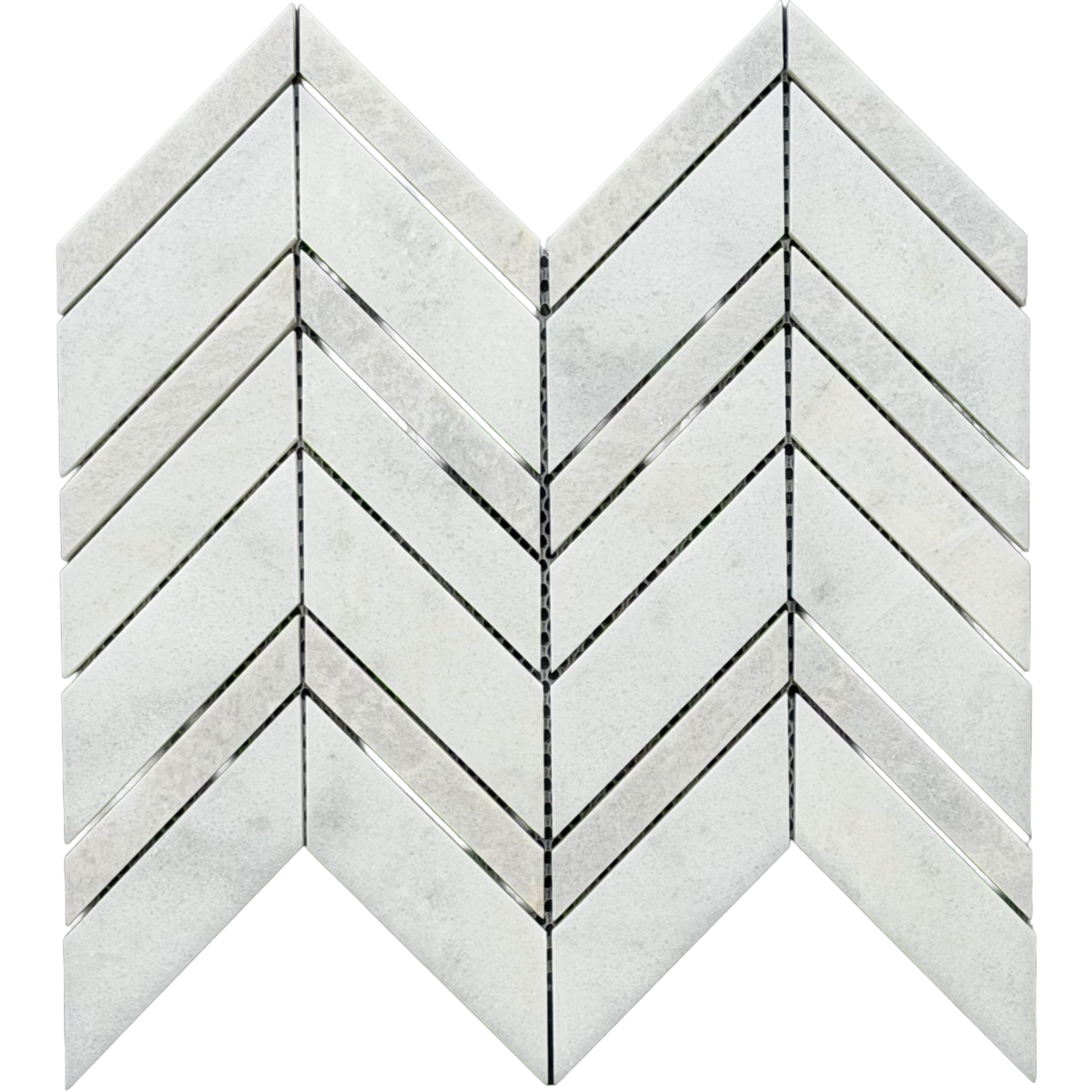
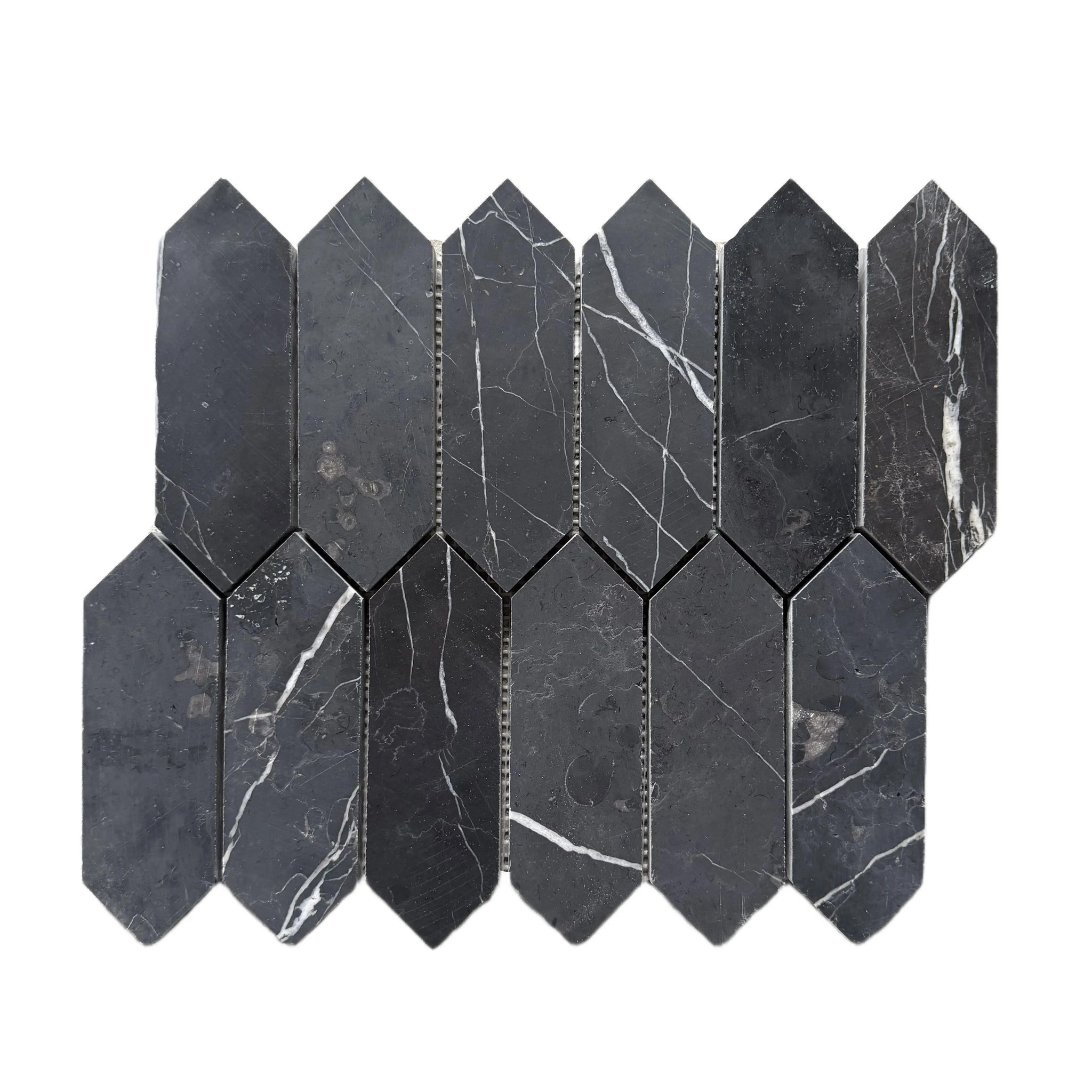
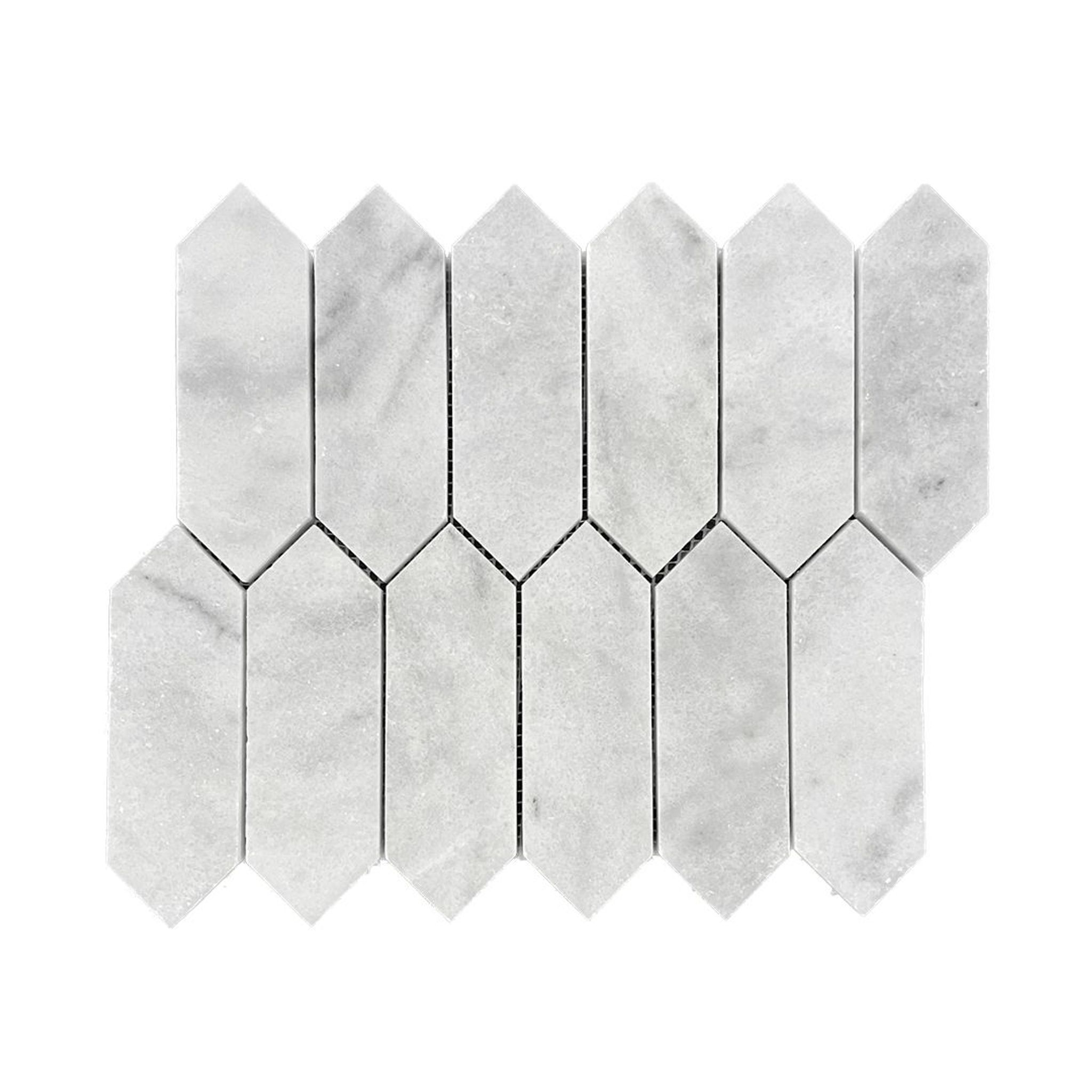
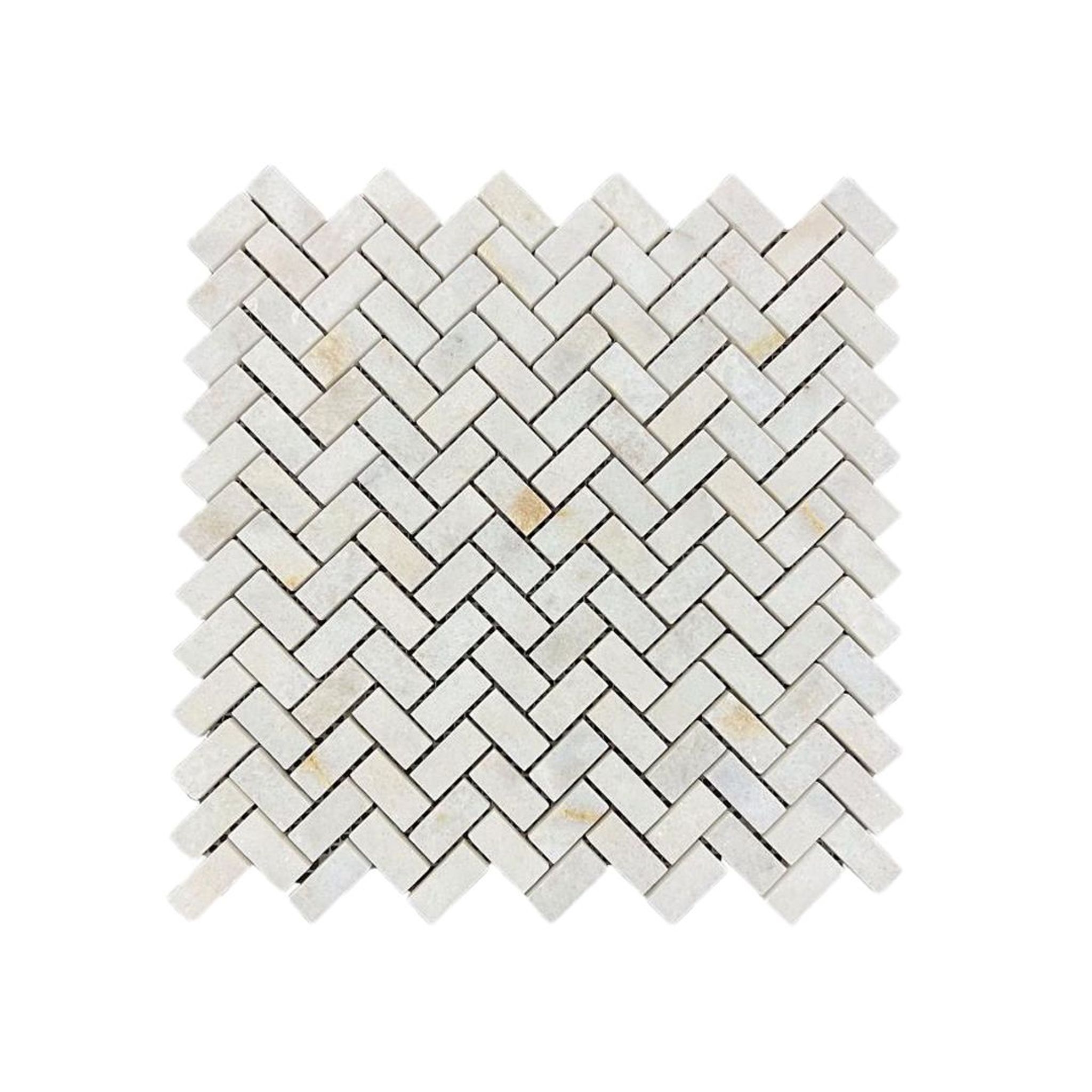
Herringbone vs chevron vs picket tile: how the patterns differ
The short version
Herringbone uses rectangles whose ends butt against the next piece, giving a stepped zigzag. Chevron uses pieces with angled ends that meet point to point, giving one continuous V, and takes more cutting. Picket is an elongated hexagon with pointed ends, laid in rows, horizontally or vertically. All three suit backsplashes, shower walls and, in honed or tumbled stone, floors; angled patterns need more overage for cuts.
What is the difference between herringbone, chevron and picket?
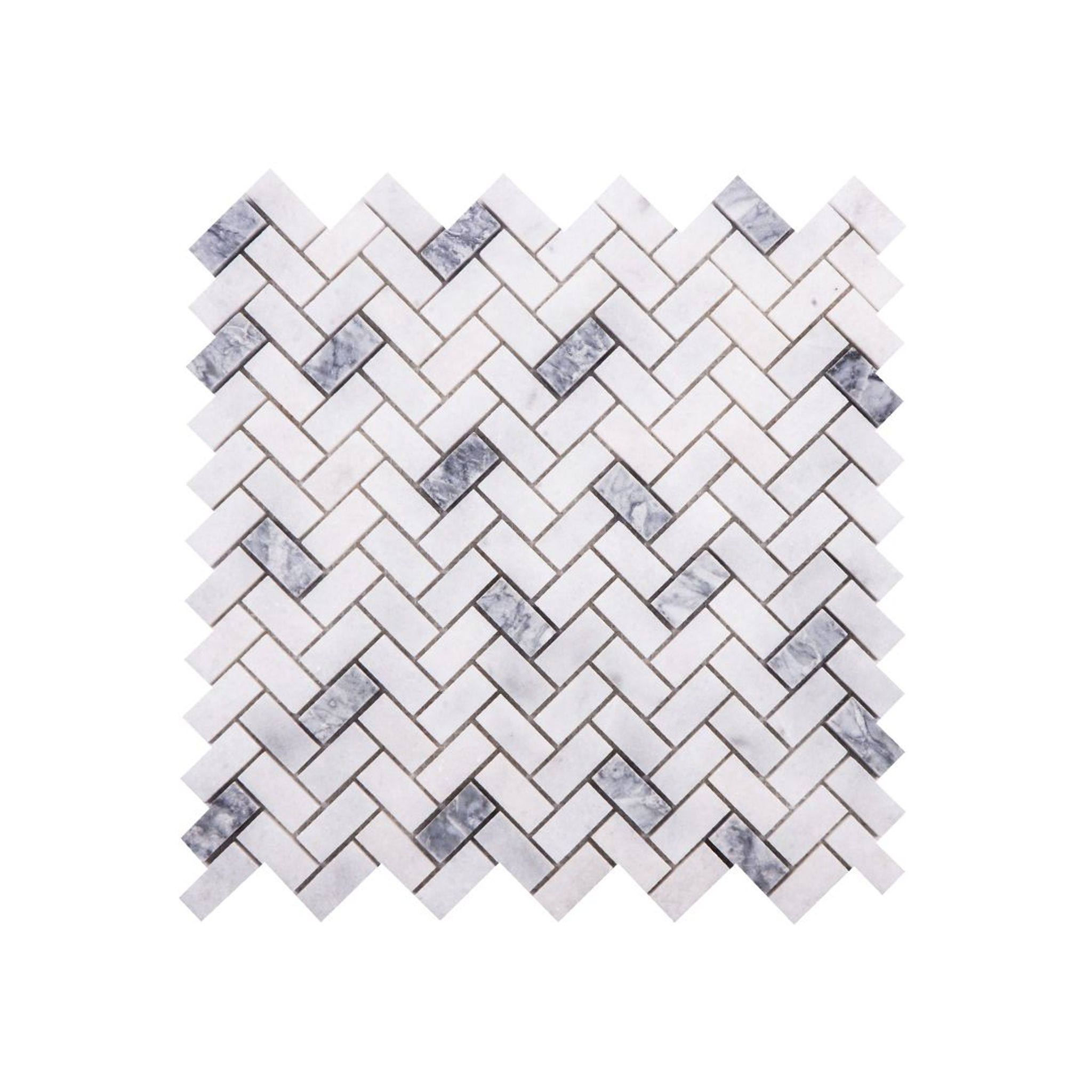
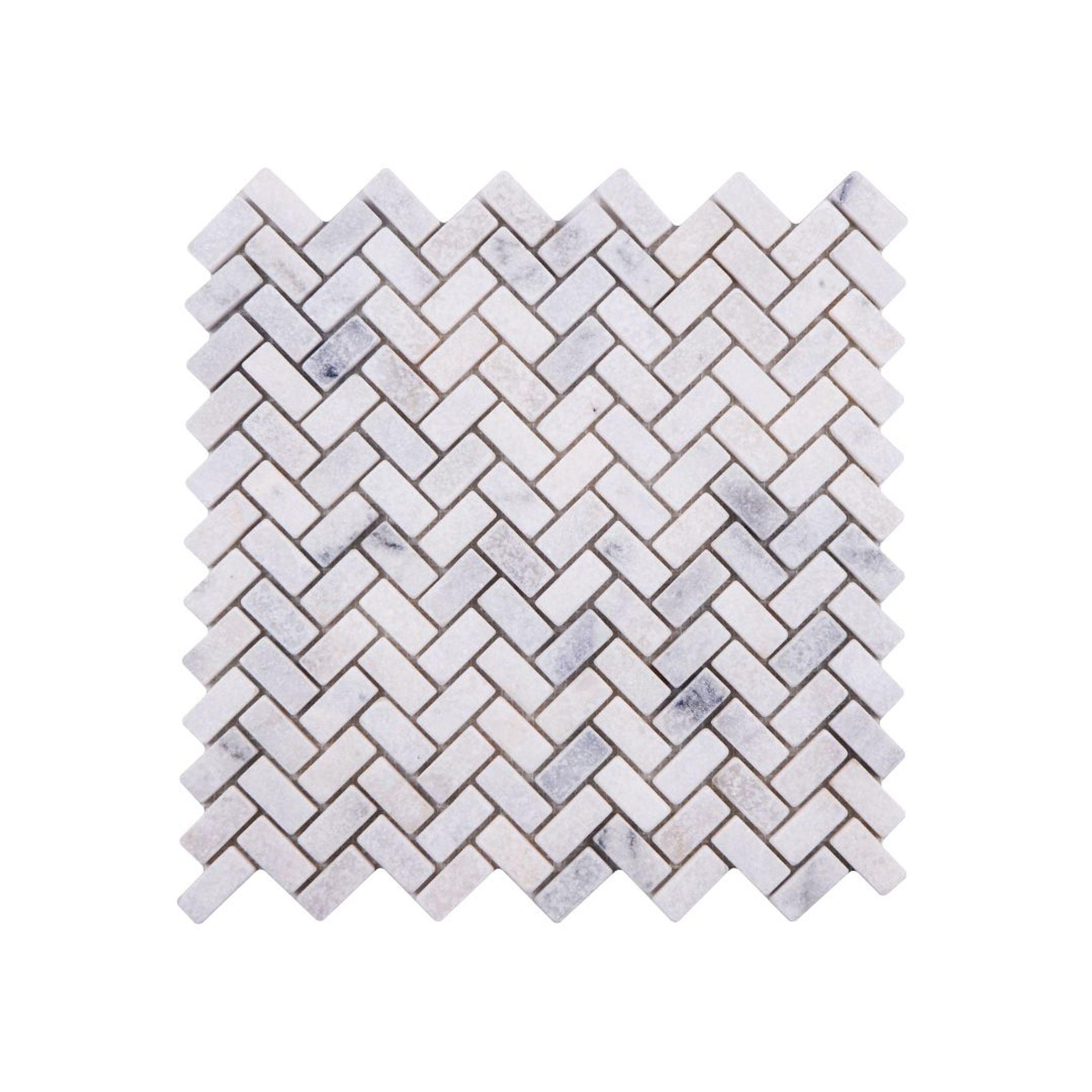
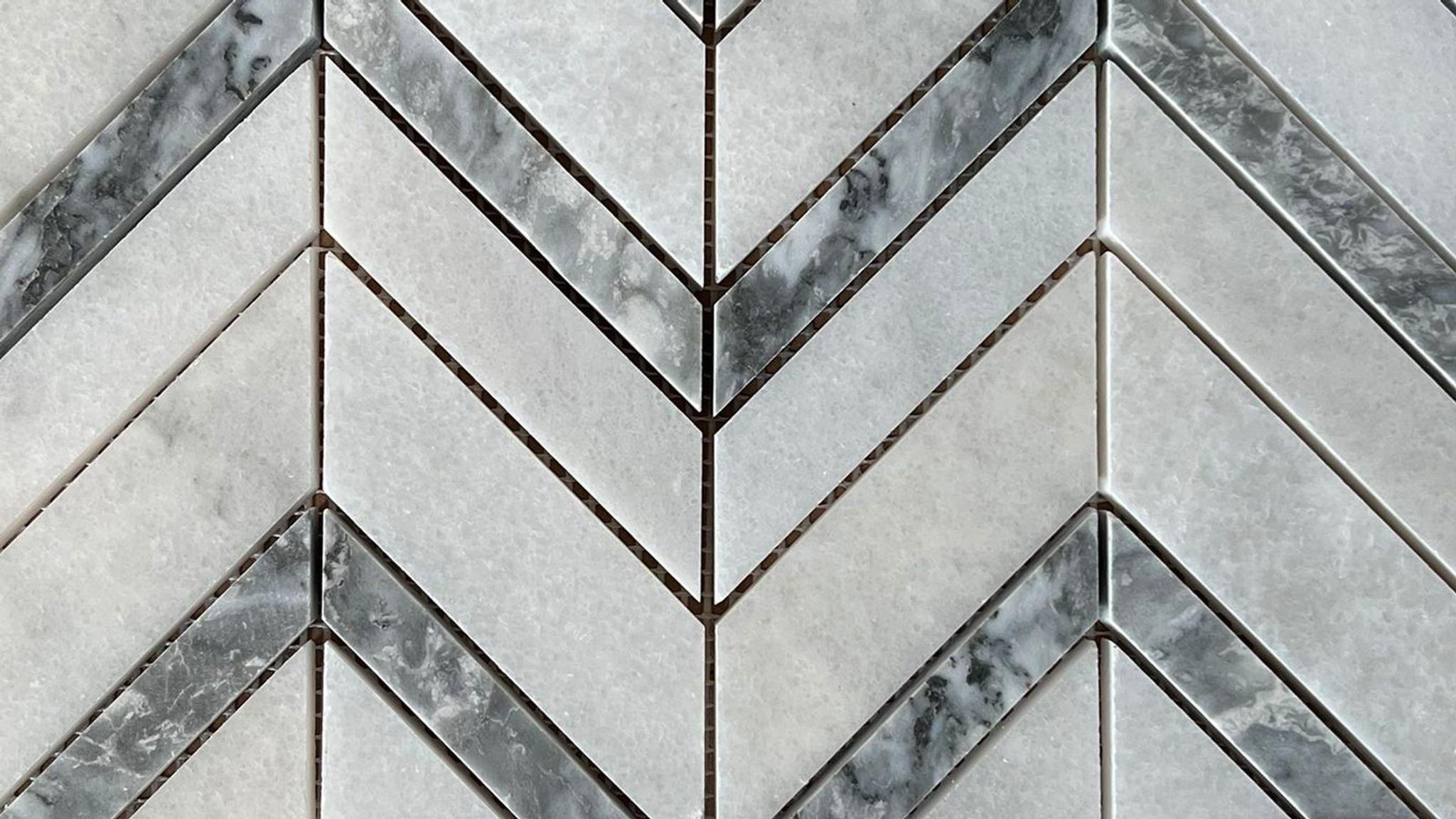
All three are patterns of long, narrow pieces, and they are often confused. The difference is in the shape of the ends. Herringbone uses plain rectangles whose ends butt against the side of the next piece, so the zigzag is broken into steps. Chevron uses pieces with angled ends that meet point to point, so the zigzag is one continuous V. Picket is a different shape altogether: an elongated hexagon with pointed ends, laid in rows rather than in a zigzag.
| Herringbone | Chevron | Picket | |
|---|---|---|---|
| Piece shape | Rectangle, usually twice or three times as long as it is wide | Parallelogram: a long piece with both ends cut at an angle | Elongated hexagon with a point at each end |
| How pieces meet | The end of one piece butts against the side of the next | Angled ends meet in a mitre, point to point | Points fit into the V between the pieces of the next row |
| Look | A stepped, woven zigzag | A clean, continuous V | Rows of fence pickets; softer and less directional |
| Layouts | Diagonal or square to the wall | Points up, down or sideways | Horizontal, vertical or braided |
What is a herringbone pattern?
Herringbone is an arrangement of rectangles set at right angles to each other, named after the bones of a fish. The pieces are usually twice as long as they are wide, sometimes three times. Each piece starts at the side of the one before it, which gives the pattern its stepped, woven look.
Laid piece by piece, herringbone is demanding, because the rows must line up closely and any error grows across the room. On a mesh-mounted mosaic the pattern is assembled at the factory, so the installer sets sheets rather than single pieces and the task becomes aligning the sheets and planning the edges.
What is a chevron pattern?
Chevron looks like herringbone at a distance, but the pieces have angled ends. Each end is cut so that two pieces meet in a mitre, point to point, and the pattern reads as one continuous V or zigzag. Because every piece needs those angled cuts, chevron takes more cutting than herringbone, which is why herringbone is usually the more economical of the two.
Decide which way the points will face before you order: up a wall, along a backsplash, or towards the entrance of a room. The direction is part of the design, and on a floor it leads the eye.
What is picket tile?
A picket is a long hexagon with a point at each end, like the top of a fence picket; it is a stretched version of the classic hexagon. The pieces fit into each other row by row, so the pattern has the rhythm of a subway tile with a softer, pointed edge.
- Horizontal: rows run across the wall, a quiet alternative to subway tile on a backsplash.
- Vertical: the points run up the wall, which draws the eye up and can make a wall or a shower look taller.
- Braided: pieces set in alternating directions for a woven look, on walls or floors.
Horizontal or vertical is a design choice, not a technical one. Look at the height of the wall, the line of the worktop and the size of the room, and lay out a few sheets before you decide.
Which pattern works where?
| Place | Herringbone | Chevron | Picket |
|---|---|---|---|
| Kitchen backsplash | Yes; reads as a texture | Yes; the strongest statement of the three | Yes; horizontal for calm, vertical for height |
| Shower walls | Yes | Yes, with the points running up the wall | Yes; vertical adds height |
| Bathroom and shower floors | Yes, in honed or tumbled stone | Yes, in honed or tumbled stone | Yes, in honed or tumbled stone |
| Feature wall or fireplace | Yes | Yes | Yes |
For floors, and anywhere that gets wet underfoot, choose honed or tumbled stone rather than polished. Mosaics have many grout joints, which helps grip.
For more on backsplashes, see our guide to mosaic backsplashes. For showers, see travertine, marble and limestone in showers.
Which stones and finishes suit these patterns?
- One stone, honed: the pattern shows through the joints and the light, a quiet look that suits Carrara and other white marbles.
- Two stones: alternating colours, such as white with grey or a light limestone with a darker stone, make the zigzag or the pickets stand out.
- Dark stone: black marble such as Nero Marquina gives a strong graphic line, especially with a light grout.
- Finish: polished on walls for reflection; honed or tumbled on floors and where the stone gets wet.
See our guide to stone finishes for polished, honed, brushed and tumbled.
Does herringbone use more tile?
No more tile covers the floor: a square metre of herringbone is still a square metre of stone. The extra comes from the cuts. Because the pattern runs at an angle to the walls, every edge needs cut pieces, and the waste is higher than for a straight grid.
Artistic Tile, a US tile company, advises 20 to 25 percent overage for herringbone and 25 to 30 percent for chevron and other complex patterns, and at least 20 percent for mosaics, up to 30 percent for intricate ones. Small rooms and many corners need more. Agree the figure with your installer, and order the whole quantity from one production run, so the colour of the stone matches.
How do you finish the edges?
Herringbone and chevron end in a zigzag, and picket ends in points, so none of them stops in a straight line at a wall, a worktop or an outside corner. The options are a cut row along the edge, a metal profile, or a stone border, pencil liner or listello in a matching or contrasting stone.
Our guide to pencil liners, listellos and borders covers the trim pieces and how to order them.
How are they installed?
Mesh-mounted herringbone, chevron and picket sheets are set like other stone mosaics:
- Dry-lay the sheets first and snap a straight reference line, so the pattern runs true across the whole surface.
- A white, polymer-modified thin-set made for natural stone, so grey does not show through light marble.
- Keep the joints between sheets the same as the joints within a sheet, so the sheet edges disappear.
- Unsanded grout for narrow joints and polished stone; seal honed and tumbled stone before grouting.
Our guide to installing marble mosaic covers the steps in detail.
Herringbone, chevron and picket mosaics from our factory
We make herringbone, chevron and picket mosaics in marble, limestone and travertine at our factory in Denizli, Türkiye, for wholesale and project orders, in one stone or two, together with the matching plain tiles and trim. Tell us the pattern, the stone, the finish, the size of the pieces and the total area, and we will quote for your specification; any size can be cut to order. See our herringbone mosaics and all our marble mosaics for examples of past production.
Frequently asked questions
- What is the difference between chevron and herringbone?
- Herringbone uses rectangles whose ends butt against the side of the next piece, giving a broken, stepped zigzag. Chevron uses pieces with angled ends that meet point to point in a mitre, giving one continuous V.
- Is chevron or herringbone more expensive?
- Chevron usually costs more, because every piece needs angled cuts at both ends. Herringbone uses plain rectangles. The stone, the finish and the size of the pieces matter more than the pattern, so compare quotes for the same specification.
- Does herringbone use more tile?
- The same area of stone covers the same area of floor, but the angled pattern needs cut pieces at every edge, so more is wasted. Artistic Tile advises 20 to 25 percent overage for herringbone and 25 to 30 percent for chevron; agree the figure with your installer.
- What is picket tile?
- A long hexagon with a point at each end, like the top of a fence picket. It is laid in rows, horizontally or vertically, or braided, and works on backsplashes, shower walls and floors.
- Should a picket backsplash be horizontal or vertical?
- Either; it is a design choice. Horizontal rows give a calm look close to subway tile. Vertical rows draw the eye up and make a wall look taller. Lay out a few sheets before deciding.
- Can herringbone or chevron marble mosaic be used on floors?
- Yes, in honed or tumbled marble. Polished marble is slippery when wet, so keep it for walls. The many grout joints of a mosaic also help grip.
- Which way should a chevron point?
- It is a design choice. On a wall the points usually run up or along the wall; on a floor they often point towards the entrance or along the length of the room, which leads the eye.